Friday, 8 November 2024

A Cultural Tradition; Remembering the Fallen

In my home country of Great Britain, Remembrance Day has always been a big part of the cultural tradition, just like it is in so many other countries that were involved in the allied forces' fight to end the First and Second World Wars. Since it is Remembrance Day on Friday this week, I thought I would use this opportunity to write more about the men with whom my husband's grand uncle Tommy flew and died. 
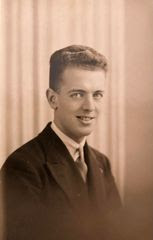
Thomas Andrew McRobbie; 1923-1944

Last June, on the 80th anniversary of D Day I posted the story of my husband's grand uncle, Thomas Arthur McRobbie, aka Uncle Tommy. His story outlined his last week, in the days running up to D Day, and how on that fateful morning his plane was the only allied aircraft to be shot down where all hands were lost. This past summer my family and I were fortunate enough to be visiting Normandy, where we visited the British Normandy Memorial, at Ver Sur Mer, and the Bayeux War Cemetery, where Tommy and his fellow British flight crew members were all laid to rest. After finding Tommy's grave, we decided to find the graves of all the other flight crew, who died with Tommy on the 6th June 1944. Tommy's  friend, and crew member Morris Campbell Murray was Canadian, and was buried at the Canadian War Cemetery, close at Beny Sur Mer, and we visited his grave too.

Morris Campbell Murray's grave marker can be found at the Canadian War Cemetery, in Beny Sur Mer.
"Until the day break and the shadows flee away"

We already knew a lot about Morris' life, before the war. His story is well researched, and made available via the Juno Beach Centre, which we also visited. My husband's grandmother and aunt remained in contact with Morris' family for a long while, which also allowed us to know about his life. But it occurred to me that we don't know much about the other men who died and were buried alongside Uncle Tommy. I decided there and then, standing in the midst of hundreds of tidy white grave markers, that I would research each of the men; an homage to these seven men who died on the day that the allied forces began to win the war against  Hitler and the Nazis.

Morris Campbell Murray, 1915-1944.
You can read about Morris' life at the Juno Beach Centre website.

Morris Campbell Murray was the crew's navigator. He was the only crew member who was not British. Born in Ontario, Canada Morris was far from home. He was 29 years old when he died on the 6th June 1944.

Sitting in position #1 was Pilot Officer S A D Walker (pilot), #2 Flight Sergeant M C Murray (navigator), #3 Sergeant N J Neal (flight engineer), #4 Flight Officer I R Draper (bomb aimer), #5 Sergeant D W H Edsall (wireless operator), #6 & #7 Sergeants P Craig, and T A McRobbie (air gunners) (Sergeant was the lowest rank a flight crew member could have. Ranks lower than sergeant were relegated to ground crew.)

Sergeant Peter Craig was an air gunner in the Handley Page Halifax III that flew from the squadron's base at Holme on Spalding Moor, Yorkshire, on 6th June 1944. Peter Craig was the son of Annie and Peter Merrilees Craig. Annie (whose maiden name was Trevis) was from Dudley, Worcestershire, in England, and I believe she met Peter, from Falkirk, Stirlingshire, Scotland, sometime during the First World War. Peter was a coal and clay miner and worked for a brick works in Dudley. They married in 1918, in Dudley, Worcestershire, and their first son was born 25th January 1920; James Thomas Craig. Tragically James Thomas Craig died on the day he turned 10 months old, after a fatal accident. A saucepan on the stove top was upset, causing the scalding hot water to hit the baby. James lived for two excruciating days before passing. The parents Peter and Annie must have been bereft at their baby's tragic loss. 

The following year, the 1921 census shows that the couple were still living in Dudley, along with her sister Florrie, and her two brothers Thomas and Henry. But they weren't to stay there for long. Perhaps as a result of trying to start afresh after the tragic loss of their first born, the couple moved to Falkirk, Scotland; Peter's home town. In 1922, Peter Craig was born, although I have been unable to ascertain his exact birth date, or if he was born in Falkirk or Dudley. Neither Scotland's People, nor the GRO have been able to locate birth records for him. Nevertheless, Peter Craig was a Falkirk son, and in 1942, at the age of 20 he married his sweetheart Margaret Miller, the daughter of a shoemaker, at St John's church, Camelon, Falkirk, Stirlingshire. At the time of their marriage Peter was working as a house painter, although the record also states that he was 'engaged in war service', and the letters "LAC RAF" were written under his name on the marriage record, meaning that when he married he was a Leading Air Craftman with the Royal Air Force. It was at the age of 20 that men in the UK were conscripted to war service, and he would have completed his basic training, enough to have achieved LAC rank. LACs were still required to be supervised and he would have been relegated to ground staff completing cooking tasks, aircraft maintenance, and/or clerical duties. I have found no record of Peter and Margaret having had any children together. Perhaps there just wasn't the time. I have been unable to find out what happened to Peter's parents, Peter and Annie. It is impossible to imagine the grief they must have felt at the loss of both their first child as a baby, and then their second child, as an adult. Peter Craig was 22 years old when he died on the 6th June 1944.

Peter Craig's grave marker is found at the Bayeux War Cemetery, in Bayeux, France.
"They Shall Grow Not Old As We That Are Left Grow Old"

Ivor Reginald Draper was the crew's air bomber. He was the youngest son of Ellen Elizabeth and Walter Reginald Draper. When Ivor was born Walter was a supervisor wharfinger at a wharf owned and run by Leach & Co, on Tooley Street, Potter's Fields, located just south of the Thames in south east central London. Walter had had quite a varied career until that point. Born in 1873, Broadstairs, Kent, Walter had worked as a fruit broker, and pawnbroker. He had been married to Ethel Hyde in 1899, but the marriage was fruitless, and clearly unhappy. Ethel filed for divorce in 1907, citing adultery and desertion as her reasons for divorce. The divorce papers didn't name the other woman or women, but it is likely that Ellen Elizabeth was the woman who had turned Walter's head. Walter married Ellen in the fall of 1908, and a year later their first child was born; Walter John Draper. Their daughter Gwendoline arrived in 1914, and then, possibly as a surprise, Ivor was born in 1921, when Ellen was 47 years old. The 1921 census shows the family living at 136 Strathyre Avenue, when Ivor was just 3 months old. In the 1939 register the family continued to live at the same address. By this point Gwendoline had married general clerk George Edward Brown in 1938, and the newly weds were living in Sutton. Walter, Ellen (sometimes recorded as Helena), and the two sons were all together at the family home, where Walter the father was a senior clerk at the Waterside Wharf, while sons Walter and Ivor were a sanitary civil engineer, and unemployed clerk respectively. 

Ivor turned 20 in 1941, and would have been conscripted in March of that year. He joined the RAF and in January the following year he married his sweetheart, 20 year old Lambeth born, Edna Margaret Filer. Ivor achieved the rank of Leading Air Craftman in March1943, and went on to climb to the rank of Flight Officer. I have not been able to establish what Ivor's brother Walter John did during the war. He married in 1934, a Jersey lass named Vera Kathleen Le Sueur. From what I can tell from records available, they lived together in Surrey, and died in the 90s. Meanwhile I believe Gwendoline's husband George Brown died during the war. I can't find a reliable record to support this, but nevertheless, Gwendoline remarried in 1956. She died in Sutton in 1988. Edna, Ivor's widow, married again in 1947, to a 35 year old architect's surveyor by the name of Herbert Todd. They lived in Surrey, and Gwendoline died in the early 2000s.  Ivor Reginald Draper was 23 years old when he died on the 6th June 1944.

Ivor Reginald Draper's grave marker is also found at the Bayeux War Cemetery.
"Ever Living In Our Hearts"

Douglas William Henry Edsall was the crew's wireless operator, and air gunner. Douglas was the son of Julia and William Edsall, and was born in Islington, London in April 1922. His father William Edsall was a true London lad, having been born in St Pancras, London, and worked as an omnibus driver for the London General Omnibus Company. Douglas' mother was Julia Mendoza at birth, and was a native of Spitalfields, London. Julia was born in 1893, at a time when Spitalfields had a reputation as being one of the most dangerous places to live. Jack the Ripper and the Whitechapel murders had come to an end just a couple of years before her birth, and notorious gangsters ruled the slums in which the residents lived. The Whitechapel murders had brought the world's attention to the awful conditions of the area, so by the time of her birth slum clearances had begun. By 1901 her family had moved to Shoreditch, a slightly safer neighbourhood, where her father worked as a leather dealer. Before marriage Julia worked as a pattern card maker, making cards for programming weaving looms.  By the time of the 1921 Census Julia and William were living in a two room apartment at 9 Elmore Street, Islington. By that time they had the first two of the four children they would have; Ronald William (born 1913), and Yvonne Lily (born 1918). The following year Douglas William Henry arrived in April 1922, and the baby of the family, Marjorie Julia Louise was born in 1932. When the Register of 1939 was taken, the family were living at 43 St John's Road, Southend on Sea, where William continued to work as an omnibus driver, and Yvonne was working as a chemist's assistant in a surgical department. Later in 1943, at the age of 25, Yvonne volunteered with the Land Girls, leaving her job as a chemist's assistant behind. Something tragic must have happened shortly before February 1944, as she quit the Land Girls, her resignation being accepted on compassionate grounds. This was several months before D Day of the same year, so I can only guess that perhaps a sweetheart had died in combat. It is probable that Douglas' older brother Ronald also saw active duty in WWII, I cannot, however, find any records as yet, relating to his service. Marjorie, the youngest sibling, was a slip of a lass in 1939, when the war began, and was recorded as a 7 year old student in 1939. She later married Ronald Stephen George Markham in 1949. Marjorie died in the 1970s. Ronald, the eldest of the four children died in 1980, and Yvonne passed away in the early 2000s. Strangely for this group of air crew members, Douglas William Henry Edsall's grave marker had no epitaph from the family, and no notes are left on the War Commission sites about those who mourned Douglas at his passing. This may have been the result of a clerical error. Douglas William Henry Edsall was 22 years old when he died on D Day, 1944.

D W H Edsall, Sergeant #1336890, is laid to rest at Bayeux War Cemetery

Norman John Neal was the flight engineer of the crew, and the eldest by far. Born in 1909 Norman was 35 years old in June 1944. As the first of five children born to Albert and Elizabeth Neal, he was used to being the eldest. Norman was also the only son and the big brother to four sisters; Phyllis (born 1910), Bertha Dorothy (born 1911), Irene (born 1913), and Margaret (born 1915). Albert, Norman's father, was  a postman, and in 1921 the family lived at 37 Princes Street, Kettering, Northamptonshire. Each of the sisters married, to men who appeared to have survived the war. Norman John Neal married Hilda Betts Tiney in the fall of 1940. Hilda was a tobacconist's ledger clerk in 1939, when she lived with her family in Thrapston, Northamptonshire. When they married Norman was 31, and Hilda was 21 years of age. There is no record of them ever having children together. It seems that Hilda remained a widow for along time after the war, only remarrying in 1983, to a John Elford. Norman's parents, Albert and Elizabeth died in 1958 and 1960, respectively.

Norman John Neal was the eldest of the flight crew.

Stanley Arthur Douglas Walker was the pilot of the Halifax III bomber. Stanley was the youngest of four children born to Ada Violet Walker. Ada and her husband, Henry James Walker were married in September 1907 at St Gabriel's, on Chrisp Street, Poplar, an area of east London now known as Tower Hamlets. Poplar was a very deprived area, and was badly bombed in the first world war, due to its thriving port. During WWI zeppelin night raids caused indiscriminate damage to buildings, and the deaths of many innocent civilians. Henry was a blacksmith and in 1911 was working for London County Council, repairing tramway lines. Unfortunately, shortly after Ada became pregnant with Stanley, Henry James Walker died, from influenza and pneumonia, in October 1918; probably 'Spanish Flu'. A few years later the small family of Walkers were living at the same home on Abbotts Road in Poplar, just one road south of the Poplar gas works. Mother Ada was recorded as a widow, with her four children, including three sons and one daughter; Henry Charles Edward (born 1909), Leslie Frederick George (born 1913), Lilian Irene May (born 1917), and Stanley Arthur Douglas (born 1919). Baby Stanley had never met his father, who died six months before he was born. 

Abbott Road runs diagonally from top left to bottom right, with the gas works just north. The colours on the map show the bomb damage done to the buildings in the area, during the WWII bombings. The dark red/black colours represent buildings that were irreparable.

It seems that Stanley's older brother Henry was a sailor, and sailed in a ship named SS Corinthic to New Zealand. In 1930 the police at Wellington, NZ issued an arrest warrant for him, due to his desertion of the ship. He was arrested on the 3rd December 1930. By all accounts, he did not return to the UK, and remained in New Zealand for the rest of his life, dying in 1980. Ada's second child, Leslie, became a fireman, and as such would have been protected from conscription. His time during the war years would have been spent doing a lot of very dangerous work, putting out fires after bombing raids on London, and so on.

At the time that the 1939 Register was taken, at the start of WWII, Ada, Stanley's mother, was working as a hospital orderly, and Lily, Stanley's sister was working as a swimming bath attendant. I have been unable to locate Stanley in the 1939 Register, so it's not possible to identify what career he had settled upon. Lily married George William Hutchinson in late 1939, or early 1940. George served as a chief petty office with the Royal Navy during the war. He was stationed on HMS Tamar, in Hong Kong when the island was invaded by the Japanese. George was taken as a prisoner of war by the Japanese, and was later put on a Japanese transport ship called the Lisbon Maru. It was on the 2nd October that the Lisbon Maru was hit by torpedoes fired by a US submarine, named Grouper. Grouper left the scene when they saw the ship going down, and Japanese sailors being taken off. What they didn't know was that in the hull of the Lisbon Maru were 1800 POW from the allied forces, who all died in the most awful of conditions as the ship sank. Lily must have been devastated to hear this news. After the war she remarried and lived in Southend on Sea. 

Ada did not appear to marry again, and died in 1967, at the age of 82. The inscription that she added to her youngest son, Stanley Arthur Douglas Walker's gravestone speaks to the grief she must have felt so keenly.


"Memories are treasures no one can steal leaving a heartache no one can heal. Mum"


Stanley Arthur Douglas Walker was laid to rest at the Bayeux War Cemetery

Thomas Andrew McRobbie was my husband's granduncle. He was the youngest child, and only son of Thomas Andrew McArthur McRobbie and Agnes Grainger Ramsey, of Edinburgh. His sister, Margaret McArthur McRobbie was 12 years his senior. It was to Margaret that the telegram was sent, advising her and the family that Tommy had died. 

"....deeply regret to inform you that SGT Thomas Andrew McRobbie is now reported to have lost his life as the result of air operations on 6/6/44 the air council express their profound sympathy [to] his mother.."

Tommy was 20 years old on the 6th June 1944, and the youngest of the flight crew.

Thomas Andrew McRobbie was an Air Gunner with Squadron 76, whose motto was "Resolute"
"At the going down in the sun and in the morning we will remember them"

The crew were initially buried by the villagers of Graye Sur Mer, where their plan had crashed, in an orchard. When we visited Normandy this summer we visited the village to see if there was any mention of their plane crashing. We found nothing, except for a very peaceful church and graveyard. After the war had ended the men were all exhumed and each was buried in the places where they remain today; the British six at Bayeux, and the lone Canadian at Beny Sur Mer. 

We happened to be staying just a block away from the Mont Fleury battery, which was their target on the morning of D Day. Bizarrely, Mont Fleury battery is now someones home. But next door, there now stands the British Normandy Memorial which we were able to walk to from the house in which we were staying. Whilst the men are no longer buried together, their names are all listed together on the British Normandy Memorial, in the central block. It is a very moving place; so very many names. This year, a special art installation was commemorating the 80th anniversary of D Day and we felt honoured to see it. I came back at day break on our last morning to watch the sun rise behind the many silhouettes of military men. This particular silhouette made me pause; that of an airman.


Whilst these men and their families lived their lives many decades ago, and the Second World War did come to an end, the world has never seen a moment's peace since their passing. This Remembrance Day my family and I will be thinking about these men, the sacrifices they made, and the loved ones they left behind, and will be hoping and praying that one day we will experience the peace for which they hoped, fought, and died. As it says on Uncle Tommy's grave,  we will remember them.

*********************************

https://www.layersoflondon.org/map/overlays/bomb-damage-1945

https://www.royalmarineshistory.com/post/the-battle-for-hong-kong-and-the-lisbon-maru-massacre-royal-marines-roll-of-honour

Thursday, 31 October 2024

Colourful; Jacquetta the Duchess, the Queen Mother & the Witch?

I love historical fiction, and one of my most favourite authors of this genre is Philippa Gregory. The series of books which I enjoyed the most, from her body of work, was the Cousin's War series, which included a book called The White Queen. It told the story of the rise and fall of Edward Plantagenet, Duke of York, who became Edward IV of England, from the perspective of his wife, commoner Elizabeth Woodville. I loved how Gregory was able to imagine and relate the story of kingship and war through the eyes of this woman, who was considered by many as a beauty. Whilst Elizabeth was portrayed as the white queen (white due to the white rose of York), it was her mother Jacquetta who was vibrantly colourful by comparison. In fact Jacquetta was my favourite character in the books, and as a result one of my favourite women in history.


The York house used the white rose to for their heraldic badge, and the house of Lancaster used the red rose. 

When I discovered that my grandfather's line connected me to the Plantagenet royal family, I eagerly traced my line back, and was so excited to discover that this colourful character from the Plantagenet era was actually my 18x great grandmother! 

Jacquetta was the eldest daughter of Peter I of Luxembourg. Peter was the Count of Saint-Pol, the area around the city of St Pol in northern France, just south of Calais. He also inherited the counties of Brienne (in France) and Conversano (in Italy). Her mother was Margaret of Baux, and was descended from a powerful family in the Provence region of France.

The Luxembourg family believed they were descended from the water goddess Melusina.

The county of St Pol can be seen near the centre of this map 

Whilst Jacquetta was known in the Gregory novels as a member of the York family, she began her life in the royal family of England, as a member of the Lancaster house. At the tender age of 17 Jacquetta married John of Lancaster, Duke of Bedford, on the 22nd April 1433 at Therouanne, in France, just north of Saint-Pol. The Duke was 43 years old, and the third son of the ruling king of England, Henry IV. The marriage was childless, and did not last long, coming to a natural end when the Duke died after 17 months of marriage, in Rouen, France. As the wife of a royal prince, Jacquetta was obliged to travel to England, to visit the king, who was by then Henry VI of England, the nephew of her deceased husband.

© The Trustees of the British Museum. Shared under a Creative Commons Attribution-NonCommercial-ShareAlike 4.0 International (CC BY-NC-SA 4.0) licence.
Jaqueline de Luxembourg at left, full-length portrait, Anne de Jauche, Philippa de Lalaing and Bonne de Vieuville in outline, all in fifteenth-century costume; after the 'Recueil d'Arras'; from Rubens' Costume Book Pen and brown ink and greyish-brown wash.

Henry VI sent Sir Richard Woodville (sometimes spelled Wydvill, Wydeville, or Wydevill) to France, to escort her to England safely. Richard Woodville was the son of another Richard Woodville, who was chamberlain to the late Duke of Bedford. Richard Woodville, the son, also worked for the Duke and so it was a natural fit to have him bring Jacquetta home to England. Richard Woodville was considered a commoner, and was far below Jacquetta's level of privilege and power, and yet on their return to England the two of them fell in love.

Poems and Romances (Shrewsbury book), illuminated by the MASTER OF JOHN TALBOT, Public domain, via Wikimedia Commons
Henry VI, as depicted in the Shrewsbury Book.

Jacquetta was quite the catch, with her dower lands reverting back to her, in her widowhood, but this was contingent on her not remarrying without the kings permission. Despite this she married Richard Woodville in secret without the approval of the king, which somewhat angered Henry VI. He refused to see them, and the happy couple were fined a whopping one thousand pounds. When the fine was paid, the king apparently forgave them, and Jacquetta was once again allowed to benefit from her dowery. 

Jacquetta did well at court, and was a favourite of the king (Henry VI) and queen (Margaret of Anjou). As the aunt, by marriage, of the King, she was the most powerful woman in the court, with the exception of Queen Margaret, and it was using this influence that her new lowly born husband was created Baron Rivers in 1448.

Margaret of Anjou, wife of Henry VI, and related to Jacquetta by marriage.

Jacquetta and Richard were a prolific couple and had many children together, including their eldest daughter Elizabeth Woodville, who was to become Queen Consort of England when she married Edward IV in 1464. Their second child, Lewis, died in childhood, in about 1438, and their third child and second daughter was Anne Woodville. Anne was my 17x great grandmother, who married William Bourchier. They had a further eleven children (14 in total); Anthony (c. 1440-1483), John Woodville (c. 1444-1469), Jacquetta (1445-1509), Lionel (c. 1446-1484), Eleanor (died c 1512), Margaret (died c 1500), Richard (1453-1491), Edward (c 1456-1488), Mary (c 1456-1481), and Catherine (c 1458-1497).

The marriage of Edward IV and Elizabeth Woodville. Illuminated miniature from Vol 6 of the Anciennes Chroniques d'Angleterre by Jean de Wavrin.

All their children, who survived to adulthood, married well, thanks to Jacquetta and their eldest sister's powerful connections. And Richard Woodville rose to greater heights as his wife and daughter used their royal connections. Before their marriage Richard Woodville was a captain and a knight. He was created Baron Rivers in 1448, and then was appointed lieutenant of Calais in 1454-55. In 1459 Richard became the Warden of the Cinque Ports, defending Kent against invasion from the Yorkist earls.

The Garter Stall plate of Sir Richard Woodville, at St George's Chapel, Windsor, created in the 15th century. 

Later, after he switched sides, from Lancaster to York, and then after his daughter Elizabeth married Edward IV, Richard Woodville, Baron Rivers, became Earl Rivers. In 1466 he was appointed Lord Treasurer and then Constable of England, the following year. The Woodvilles were on their way up, in part due to Jacquetta's power and influence; rare in the very much male dominated world of medieval England.

Whilst the many Woodvilles were happy with their new found influence and prosperity, there were a few in the royal court, who were not. Edward's brothers George and Richard Plantagenet, and Richard Neville, Earl of Warwick (known as 'The Kingmaker' due to his excessive power, wealth and resulting influence) did not like that this family of commoners were doing so very well. Finally things came to a head in 1469, when Warwick truly fell out with Edward IV, and threw him from the throne. While 'King Warwick' held the kingdom he had Earl Rivers and his son John captured, and executed at Kenilworth on the 12th August. 

An imagined portrait of Richard Neville., Earl of Warwick (aka The KingMaker) painted in the 16th century by an unknown artist.

It was not long after this execution that Jacquetta was accused of witchcraft, by a Warwick 'hanger on'; Thomas Wake. Wake had a lead figurine which he claimed Jacquetta had created, with the purpose of using it for witchcraft and sorcery. The claim against Jacquetta fell apart when Warwick released Edward, and he climbed back on the throne. The King's Great Council cleared Jacquetta of all charges made against her on 21st January 1470. 

Jacquetta died in 1472, at the age of 56, but the allegations of witchcraft were raised again, in 1484, when Richard III (Edward's younger brother) claimed that Jacquetta and Elizabeth her daughter, had used witchcraft to bewitch Edward, and secure the royal match. Richard did not offer any proof to back up these claims, and, as history tells, he died in 1485, losing the crown for the Plantagenet's forever more, and thus it passed on to the Tudor dynasty. (Richard's body famously was found in recent years, buried underneath what had become a Leicester city council car park.)

The earliest surviving portrait of Richard III, painted by Barthel in about 1520. It is owned by the Society of Antiquaries, in London. 

The Cousin's War (nowadays more commonly known as the War of the Roses) was brought to an end when Edward and Elizabeth's eldest daughter, Elizabeth of York, married prince Henry, the son of Henry Tudor (Henry VII). Elizabeth of York, and Henry VII had seven children together, most notably Henry VIII, their third child, and second son.

When the War of the Roses came to an end, the houses of York and Lancaster were united through marriage. To symbolise this union, the white rose of York, and the red rose of Lancaster were combined to create the Tudor Rose.

In the books by Philippa Gregory, Jacquetta is portrayed as an actual  witch, who used her powers to protect her family and ensure they rose to the highest ranks of the land. She was not described as a Halloween witch, wearing the traditional black pointy hats and  riding broomsticks, etc. Instead her character was closer to a white witch, not creating anything evil, but good, positive vibes that helped her family. This characterisation was undoubtedly a large part of what I found so colourful about Jacquetta's character in the novels. The real witchcraft accusations were quite clearly an effort, from those who disliked her and her family's power, to move her aside, and remove her from the ear of the king. Whilst the witchery of Jacquetta was clearly an illusion it doesn't diminish my draw to her. The fact that she married (Richard Woodville) for love, and against the wishes of the monarchy, and then despite that 'faux pas' managed to rise to such heights, bringing her husband and many children with her, retains her colourful character, without the need of witchcraft and sorcery. I remain bewitched by her!

#Newell

****************************************

https://en.wikipedia.org/wiki/Peter_I,_Count_of_Saint-Pol

http://www.maproom.org/00/36/present.php?m=0056

https://en.wikipedia.org/wiki/County_of_Saint-Pol

https://en.wikipedia.org/wiki/Richard_Woodville,_1st_Earl_Rivers

https://en.wikipedia.org/wiki/Elizabeth_of_York

https://en.wikipedia.org/wiki/Henry_VII_of_England

https://en.wikipedia.org/wiki/Elizabeth_Woodville

https://en.wikipedia.org/wiki/Jacquetta_of_Luxembourg

https://en.wikipedia.org/wiki/Edward_IV

Monday, 28 October 2024

Challenging; An Itinerant Physician in the Era of the Witch Hunt

This week's post has been made possible by the help of my marvellous neighbour and friend, Sheila McIntyre, who teaches various courses in American History at SUNY Potsdam, including one about witchcraft in the early communities of New England. She has helped me with the information I relate below, including the books mentioned, 'Medicine and Healing', and 'Witch Hunting in Seventeenth Century New England'. I am sure she will be appalled at my terrible attempts at citations. I am not an academic writer, and write purely for the love of sharing what I have found out about my ancestors and their lives. I hope she will forgive me, and know that I am so grateful for sharing her knowledge with me!

The writing prompt for this week's piece is very timely, especially with our proximity to Halloween, and all that is spooky! This week's ancestor is none other than Dr Phillip Reade (sometimes spelled Read, or Reed). I am connected to him via my 3x great grandmother, Sophia Reed, who was married to George Newell, and mother to my 2x great grandfather Frederick Newell. It was Frederick who, as one of the many mariners in our family, sailed from New England to Scotland, and there met my 2x great grandmother Christine Hall Main, thus bringing the Newell family back to Britain, after a 200 year hiatus in the USA.

Dr Phillip Reade was my 8x great grandfather. He was born in England in 1623; his father (a student of divinity) coming from Kent, according to 'The History of the Reed Family in Europe and America'. The family were first mentioned in Woburn, MA, but Dr Reade himself settled first in Lynn, and then later in Concord, MA. Phillip married Abigail Rice in 1669, at the age of 46. Together they had four children; Phillip (1671-1720- my 7x great grandfather), Jacob (born 1673), Abigail (born 1675), and Amy (born 1678). Dr Phillip Reade's story includes an interesting professional life, a fair number of appearances in various trials, including ones involving accusations of witchcraft. It is always challenging when we are confronted by ancestors whose beliefs are so glaringly different from the beliefs we hold today. 

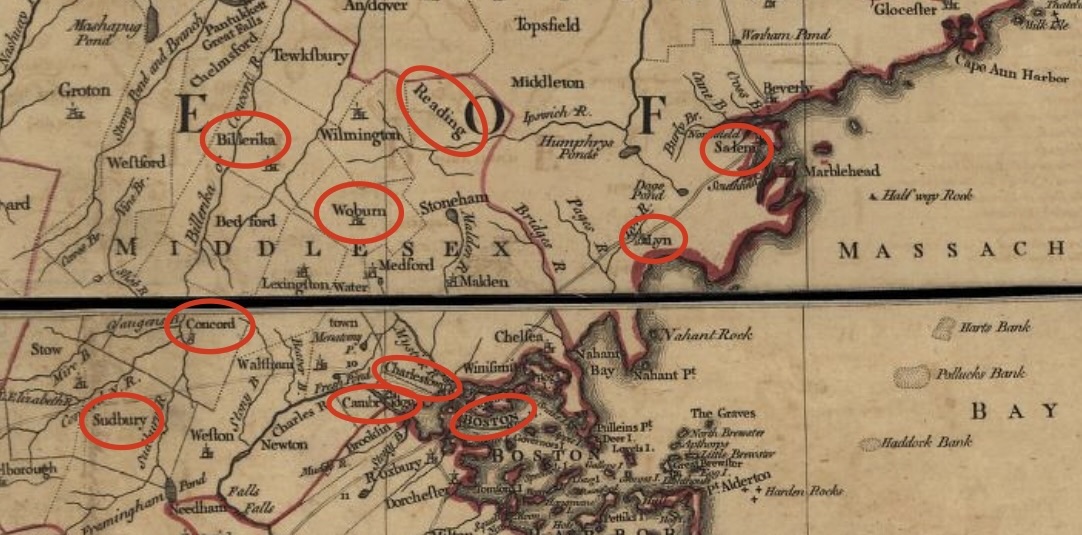
Dr Phillip Reade served several communities in New England, including Concord, where he lived, and all the way out to the coast at Lynn, and further north at Salem. He would have travelled long distances to see his patients all living in various, fairly isolated communities in a roughly 400 square mile area. 

Dr Reade visited patients in Concord, Billerika, Woburn, Reading, Lynn, Salem, Boston, Charlestown, Cambridge, and Sudbury.

He would see patients at inns and 'ordinaries', which were sort of 17th century community centres. He was not entirely a successful medic, as there are records of several cases made against him, regarding his under or over doctoring skills, and bills. There are, however, reports that he was a diligent medic;

'In 1670 six men certified they had observed Reade at work in their own houses and elsewhere when he took care of the sick and lame, "and some of us have observed him to bee carfull in his practise of physick and chirurgery and have Reseived Good by his care and industry."'
(The Trials of Phillip Reade, Rapoza; Medicine and Healing, page87; published by Boston University, 1992)

Around the time of King Phillip's War (the war between the colonists and a group of indigenous people of the Northeastern Woodlands) Dr Reade travelled with Major Willard, who commanded the troops of Middlesex county, and was the second highest paid in those forces, in January 1676, after Major Willard himself. The first of the doctor's stories that I find challenging happened a few years before, in 1669, at Lynn, and relates to a lady by the name of Ann Burt.

Major Simon Willard

Ann Burt and her husband had arrived in the colony in 1635, and settled in Lynn. By 1669 Ann Burt was a widow. She was a known healer in her community, but in 1669 was accused of witchcraft by several people. One of the people who Goody Burt was said to have afflicted was Sara Townsend. Dr Phillip Reade was asked to testify in this case;

'...he had no opportunity to examine her condition but did plainly perceive there was no natural cause for such unnatural fits[.] But being sent for the fourth time and finding her in meet capacity to give information of her aggrievance and cause of her former fits she told me the above  Burt had afflicted her and told her if ever she did relate it to anyone she would afflict her worse[.] One hour after she had a sadder fit than any ever she had afore: then I asked her who afflict[s] her now and what the matter was[.] She replied with a great screech she had told me already and that she did now suffer for with it much more now.'
(Witch Hunting in Seventeenth Century New England, by David D Hall; Three Ambiguous Cases (1669-1681), page 186; published by Northeastern University Press, 1991)

Of course, as a female healer, Ann Burt was at risk of such accusations. Dr Phillip Reade might also have benefitted from her not being able to practise healing; with less competition he would potentially increase his income. There are no records of any trial against Goody Burt, so perhaps she was acquitted. Ann Burt died in 1673.

It seems that Lynn was not a great place for our doctor. In 1679 it was in the town of Lynn that Phillip Reade fell out with a couple by the name of Gifford. John and Margaret Gifford were residents of Lynn, and John had been described as a 'stormy petrel of Essex County and litigant par excellence.' Doctor Phil had started a big argument between himself and the Giffords, by calling John a 'cheating dog', because Gifford had cheated a friend of his out of one thousand pounds. But what Reade did next was, with the benefit of modern hindsight, inexcusable. He accused Margaret Gifford of witchery by saying;

'...for there were some things which could not be accounted for by natural causes.... [others had been] strangely [and] badly handled by her'

Margaret Gifford later met Reade at the ordinary in Reading, where she told him that she had been cleared of his accusations. She had not stood trial, however the pair were furious with Dr Reade and the matter was not over.

It was in fact, October 31st (it's not lost on me that this was Halloween!) 1679 that Phillip and John met again, on the road to Salem. Reade was going towards the town, travelling east, and Gifford was coming west, away from the town. It was at this meeting that Gifford claimed that Dr Reade assaulted him, cutting him on the hand and elbow with his sword. Reade, of course, claimed that he was the injured party, and that it was Gifford who had struck him, and kicked him in the chin. In the ensuing trial over this matter Dr Reade reasserted his accusation of witchcraft against Gifford's wife Margaret, and even started painting John with the same brush accusing him of 'haveing Sum familiaritye with Satan or his instruments.' Margaret was ordered to appear in court the next day, but Reade's accusations of devilry against John Gifford were largely ignored. As it happened Margaret never did appear in court, and like Goodwife Ann Burt, she never sat trial. 

By unattributed - William A. Crafts (1876) Pioneers in the settlement of America: from Florida in 1510 to California in 1849[1], Pioneers in the settlement of America: from Florida in 1510 to California in 1849. edition, Boston: Published by Samuel Walker and Company, Public Domain, https://commons.wikimedia.org/w/index.php?curid=17689791
The Witch Trial Craze of Salem began in 1692, and its possible that both Goody Burt and Gifford avoided further trouble from Reade's accusations because they predated that time. Had the accusations been made in 1692-3, things could have been very different for Ann Burt and Margaret Gifford.

On the face of it, it is hard to understand or excuse Dr Reade's accusations, but perhaps I'm being too hard on him. Our 17th century ancestors thought the world worked in a very different way than our understanding about how it does now. The science of the 1600s was not the science of today, if indeed you can call it a science by today's standards. Instead religious beliefs, and superstition ruled the hearts and minds of the people, and as much as we would like to think that our ancestors were people with knowledge and understanding like you and me, they were not. Dr Phillip Reade was, however, a challenging man in many other ways, not necessarily to me, but to his fellow colonists, some of whom were members of his own family.

The doctor's dispensary and the apothecary's shop in the 17th century. Pictures facing title page of 'The expert doctor's dispensary' by Nicholas Culpepper (1616-1654) et al. Rare Books Keywords: Physicians; Herbalist; Drugs; Pharmacy; Herbal remedies; Apothecary; Medicine
Dr Phillip Reade would have travelled to larger towns where he would have stocked up on medicines, and treatments.

It seems that Dr Phillip Reade was an incredibly cantankerous sort, who possibly made more enemies than friends. In August 1669 warrants were issued for the apprehension of a Robert Williams who had been heard to say that he would 'have the blood of Doctor Read.' Phillip was apparently in fear of his life, and the reports that Williams had also said that he would 'get a club and.... knock out the doctors brans' surely did not help his anxiety. The records only give us a glimpse of why Williams was so upset with Reade; 'Dr Read had given him such Language as that he would not bear it though it cost him his blood.' No verdict was ever reached, as Williams ran away. 

Another time Reade sued Ambrose Makefasset who reportedly said that Reade's mother (and supposedly my 9x great grandmother) was a whore! That truly does sound awful, but what was it about Reade that rubbed people so entirely, up the wrong way?! I can't imagine that the deeply religious people of the colony would use such language without having a great many buttons pressed.

Stony Ground, by Edwin Austen Abbey, shows a Puritan pastor preaching to a family around the dinner table. Whilst the Puritans were deeply religious, they did not abstain from drinking alcohol.

Phillip Reade was not just nasty to his neighbours, but also turned his spite on his mother-in-law (another of my 9x great grandmothers!) In 1671 Abigail Rice, his wife (and my 8x great grandmother) was desperately ill. Abigail's mother, Mary Rice, suggested to Phillip that he pray to God that his wife would recover, and this reasonable suggestion ignited the fuse for this explosive response;

'ye Devill take you and yor ch[ris]t... ye Divel take you & yor prayers'

Later on, Reade shared with another person that his mother-in-law infuriated him, saying 'the Devill take her for she brought [me] to it'. Reade was accused of blasphemy, an offence that carried the death penalty, and he was taken to the prison in Boston, ahead of his case being tried in court. The charges were not found to be proven, and he escaped being hung, yet he was admonished, and ordered to pay the court costs. 

In his lifetime Dr Phillip Reade spent at least a couple of times in jail. He was ordered to pay a fine of twenty pounds for making nasty comments against Reverend Bulkely in 1670, which he was unable to pay. For this he was sent to the Boston jail, and then was moved to the Cambridge jail, while the family tried to raise the funds. His wife, Abigail, in pleading to the court, gave an inkling to the reason behind his nastiness. She argued that her 'greatest feare is... he would injure himself Lying under soe many temtations.' The temptations being alcohol.

By Price - http://maps.bpl.org/details_10913, Public Domain, https://commons.wikimedia.org/w/index.php?curid=10475205
This map from 1745 shows the location of Boston jail.

It seems that as well as a mediocre doctor, Phillip Reade was a nasty drunkard. An earlier court case recorded the testimony of Ann Adams of Cambridge, who reported that Reade had come to her house 'much overtaken in drinke, & in such a condition that wee could not get rid of him, but were forsed to entertaine him till the morneing and that he uttered sundry evil & reproachful termes against Captain Gookin' (one of the magistrates who often sat on Reade's cases). 

Whilst I might be able to forgive Dr Phillip Reade for his accusations of witchcraft. I think it's certainly clear that his fellow New Englanders found his nasty drunk self to be challenging. He left behind him a litany of records citing unpaid bills, fines, and hate filled spiteful commentary; all symptomatic of a life of an alcoholic. He died in Concord, MA on 10th May 1696, at the age of 73. Just three years earlier  he had been sued for slander, after saying that John Clarke's wife had the French Pox (syphilis.) It seems that our Doc Reade remained the cantakerous old drunk he always had been, and that even his 70 years had not mellowed him. 

Yup- Dr Phillip Reade was most definitely challenging, in plenty of ways!

#Newell

***********************************************

https://digital.nls.uk/histories-of-scottish-families/archive/94790627#?c=0&m=0&s=0&cv=287&xywh=-258%2C162%2C5442%2C4034

https://www.loc.gov/resource/g3720.ar079701/?r=0.569,0.555,0.156,0.085,0

https://www.wikiwand.com/en/articles/Samuel_Willard

Tuesday, 22 October 2024

Lost Contact; The Funnell Sisters

My great grandmother was Alice Funnell. She was born in 1880, in Brighton, Sussex. She was the oldest of three sisters, and I believe they had a strong bond, possibly formed by the death of their mother, when they were young, and then solidified when their father remarried a woman who was not keen on raising someone else's children. Their subsequent lives, and the following generations lead the Funnell sisters to live their lives at different ends of England, and their descendants at different ends of the earth. But thanks to modern genealogy tools, that contact is no longer lost.

Brighton Pavillion, the royal seaside home.

Mary Jane Vinall (my 2x great grandmother) was a Brighton girl. She was one of several generations who lived in the St Peter's ward of Brighton, Sussex, not far from the Brighton neighbourhood known today as North Laine. North Laine is now considered a bohemian, cultural quarter of Brighton, but back in the 1800s this area was considered a slum neighbourhood, and a far cry from the gentile parts of town that drew the wealthy to Brighton. Mary Jane was the daughter of Henry Vinall (a painter, who I wrote about in 'Health' week), and Jane Munro, a laundress (who I wrote about in one of my first posts, 'Origins'. Mary Jane was the youngest child of 8, born to Henry and Jane, in 1856. Her next older sister, Louisa, who I believe played a major part in Mary Jane's daughter's lives, was born just two years earlier in 1854.

Mary Jane Vinall married Joseph Funnell, a miner, on 29th September 1878, at St Peter's church, Brighton. Mary Jane's address at the time of their marriage was 4 St Peter's Street, and Joseph's was just a stone's throw away, at 14 New England Street. They were definitely a local pair! Joseph's father was Jesse Funnell, a gardener, and his mother was Caroline Pierce, the daughter of Alfred, a labourer. These were solid, working class people, who would have lived in small cramped conditions, with poor sanitation, on meagre earnings. Their lives would have been markedly different in all manner of ways from my Money ancestors, who lived in Brighton at the same time, and who I recently wrote about in my two 'Most' posts.

St Peter's church, Brighton

Two years after their marriage, and at the age of 24, Mary Jane and Joseph welcomed their daughter Alice (my great grandmother) to the world. Born on 18th September 1880, at 37 Queens Gardens, Brighton, Alice was to be the eldest of the three sisters. By the time of Alice's birth Joseph was working as a railway labourer, presumably at the nearby Brighton Railway Station, which was built in 1840-41. Whilst this work may have offered a more reliable wage, it was likely just as dangerous; there was no such thing as Health and Safety in 1880!

When Alice was 2 years old, her sister Louise arrived. The small family were, by now, living at 4 St Peter's Street, with her parents, Henry and Jane Vinall, and brother Charles, and sister Louisa. Mary Jane, Joseph, and Alice had moved here prior to 1881, and were listed as residing at the address in the census of that year. Number 4 was not a large house by any means. The terraced houses on St Peter's Street are still standing, and I would guess that it is a traditional '2 up/ 2 down', workman's cottage, meaning that inside there would likely have been a couple of rooms on the ground floor, and a couple on the floor above. Not much room for 6 adults and 2 infants.

Two years later the family were living at 7 Park Crescent Road, Brighton, and it was in this family home that the youngest of the three sisters was born. Margaret Funnell was born on 2nd November 1885, when her oldest sister Alice was 5, and Louise, the middle child, was 2. 

Mary Jane conceived a fourth child, but this time her pregnancy did not progress as it should. On the 16th April 1888, at the age of 32, Mary Jane Funnell died, as she miscarried her child. Going by the death certificate, and after consulting some medical friends, it seems likely that Mary Jane suffered from a DIC (disseminated intravascular coagulation) as a result of her miscarriage, which caused her body to go into shock, in turn causing convulsions. This would be a rare domino effect of conditions today, but in the 1800s it may have been more common due to poor nutrition, or lack of antibiotics. Mary Jane's three young daughters were motherless. Alice was 7 years old, Louise was 4, and little Margaret was just 2 years old.


Mary Jane Funnell's death certificate

Less than a year later Joseph, the girls' father, remarried. With three daughters to care for he would have needed someone, to help look after them while he went out for work. Joseph married Sarah Jane Marshall at the Brighton Register Office, on the 11th March 1889, when Joseph was a labourer, and Sarah Jane was a laundress at the Albion Hotel. The Albion Hotel was one of the most famous hotels in Brighton, and the building that previously stood on the same ground was part of the reason why Brighton, and British seaside towns had become so 'en vogue' in the Regency era. 

The Royal Albion Hotel

Richard Russell was a physician, and Sussex native. He encouraged his patients to bathe and drink seawater, and built Russell House on the seafront at Brighton in the mid to late 1700s. Russell House was where Dr Russell lived, and ran his treatment centre. The back doors of the house opened out onto the beach where bathing machines would enable his patients to get in and out of the sea in a modest fashion. The Albion Hotel became the Royal Albion in 1847, and towards the end of the 19th century the hotel was in decline, eventually closing for renovations and refurbishment in 1900. It seems that Sarah Jane was working at the hotel when the glory of this once beautiful building was definitely fading. 


Sarah Jane may have been happy to leave the hard work of laundress at the decaying hotel, but according to reports from fellow descendants of the sisters, she was not particularly happy about mothering the little girls. In 1891, Joseph, two of his daughters, Alice and Louise, were living with the 'wicked stepmother', at 4 Hastings Road. I've been unable to locate Margaret, who would have been 6 years old at the time of the 1891 census of England. Perhaps little Margaret annoyed Sarah Jane too much and she was sent away, although I've not found her with any of the Vinall or Funnell extended family. Perhaps her being omitted was an enumerator error. 

Traditional tales, like Cinderella describe strained relationships in blended families.

In the following census report Alice had left the family home, to work as a general servant for a local wine merchant. In the same census I have been unable to locate Louise, or the step mother Sarah Jane, but it seems likely that Margaret and Joseph were living at 89 Carlyle Street, where Joseph was recorded as a 'navvie', which was a slang term for a labourer working on a railway construction.

So, for those two decades it's hard to know what was happening with the three sisters, and how they fared. Things begin to become clearer as we journey through the next decade. In 1909, my great grandparents married at All Souls, Brighton. They lived at 23 Warwick Street, and William Edgill, my great grandfather, was a cook. Warwick Street no longer exists; some of the houses were pulled down in the 1930s as a slum clearance measure, and the entire neighbourhood was redeveloped in the 1960s.

Louise was the next sister to marry, shortly before the 1911 census. She married a wonderfully named tobacconist, called Havelock Desire Turner, from Harrow. At the time of her marriage to Havelock Louise was working as a maid servant at the St Clere Estate, near Sevenoaks in Kent. By the time of the 1911 census Louise was still working at the St Clere Estate, as a laundry maid, alongside her younger sister Margaret, as yet unmarried, and also employed as a laundry maid. St Clere is a large estate, and Georgian country house in Ightham, near Sevenoaks in Kent. The property was owned by Sir Mark Edlman Collet, in 1911; the son of an earlier governor of the Bank of England. 

The St Clere estate is often used today, as a film location.

In the 1911 census, Alice and her husband of 1 year, William, were working together below stairs, at a house near Winchester, called The Firs, Twyford. William was the cook, and Alice was the house parlour maid, for the family of Harry Merrill Colebrook, and 'importer of foreign corn'. They had one child together, but she was not living with them. Their daughter Mary Margaret Louise Edgill, and 11 month old infant, and 'nurse child' was living with the Hurdle family, at #2 St Peter's Street, Brighton, just next door to Alice's aunt Louisa Vinall (older sister to Mary Jane). It struck me, when I found the record, that Alice had named her first born child and daughter for her mother, and two sisters, and that the child was entrusted with her aunt, and neighbours, while her and William were working in service.


Margaret had her big day later in 1911, when she married Joseph Stoker Varey, an estate labourer from Ulleskelf, Tadcaster, Yorkshire. They married at Kirkby Wharfe parish church on the 28th October 1911. Margaret's address recorded on the marriage certificate was 'Brancaster' which is in Norfolk, and I've tried to figure out how Margaret, a maid from the south of England, ever met an estate labourer in Yorkshire. The best I've come up with is that perhaps Margaret travelled with the Collet family, as sometimes staff did, for a stay at an estate in the Tadcaster area. Not far from Kirkby Wharfe is an estate called Grimston Park, which could fit the type of estate the wealthy family might have visited, bringing an entourage of staff. That said, I've not located a big fancy house in Brancaster, Norfolk, and cannot account for her address there. How they met remains a bit of a mystery, but met they did!

Grimston Park, near Tadcaster. Possibly the estate where Margaret and Joseph met, when working in service there.

Alice and William went on to have 3 more children; William Nicholson Edgill, Edith Alice Edgill, and James Ernest Edgill. Before 1913 they moved to Sutton where William had a job as a cook at Banstead Lunatic Asylum; you can read more about his story here. Alice was a home maker and stay at home mother, as were most married women in that era. 

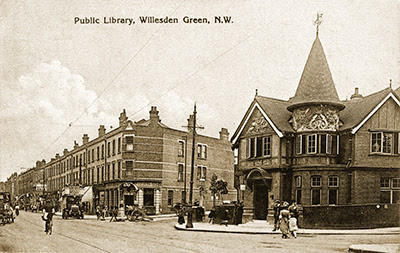
Louise and Havelock welcomed their first child in June 1911; two months after their marriage. Lillian Mary was born in Brighton, when her parents were living at 4 St Peter's Street, with Louise's aunt Louisa. Their first three children (all daughters) bore the names of the important women in their lives; Lillian Mary, Janet Alice, and Margaret Louise. Louise and Havelock did not remain in Brighton, and when they had their second daughter, Janet Alice, they were all living in Wembley, on Lancelot Road, and  Havelock, no longer a tobacconist, but was working as an insurance agent instead. By 1915, the family had moved again, to Sandringham Road, Willesden Green, where Havelock was a store keeper (yet another job change!). At this time Margaret Louise, daughter #3 was born. They went on to have a further four children, all boys; Frederick George, William Frank, Arthur Henry, and Anthony Francis.


Meanwhile in Yorkshire, Margaret was equally busy, birthing a child pretty much every two years; Joseph Charles (1912), Olive Betty (1914), Doreen (1916), George Francis (1918), Richard Stoker (1920) and John Thomas (1923). The year after, in April 1912, their aunt Louise died in Brighton, at the address that had been home to several generations of Vinalls, since at least 1851. Alice had been with her at her passing, and was the person who registered Louisa's death.

Louisa Vinall's death certificate

The 1921 census showed how all three women continued with household duties and  raising their children, each in their own corners of the country. Alice lived with her children and husband William, now a mental nurse at Banstead Mental Hospital, at 34 Kings Road, Belmont. Louise was still on Sandringham Road, Willesden Green, with her family. At this time Havelock was still a store keeper, but also had yet another job; a motor engineer for the New Engine Company, at Willesden Motor Engineers. Margaret was in Ulleskelf, Tadcaster, Yorkshire with her family, where Joseph her husband was a general labourer.


The first of the sisters to die was my great grandmother, Alice. She died on the 12th February 1934, at her home on Kings Road, Sutton, from cancer. She was 54, and her children were between the ages of 24 and 12 at the time of her death. Her youngest daughter was 19 at the time, and with her older sister by then married, it fell to her to run the house, and care for her 12 year old brother. William, Alice's husband, died in 1938, just four years later, from tuberculosis. 

At the start of WWII the National Register of 1939 was taken, and it's records show the surviving sisters continuing to live in their chosen home towns. Louise was living in Willesden, at 11 Strode Road with Havelock, now working as a laundryman. Her two youngest daughters (Lillian, and Janet), and her three eldest sons (Frederick, William, and Arthur) were at home with her and Havelock. Margaret Louise had married earlier that year, and the baby of the family, Anthony Francis was living in Northamptonshire, possibly as a 13 year old evacuee.

Margaret was living with her husband Joseph, who was working as a road man for West Riding County Council. Her two adult sons Richard Stoker, and John Thomas were living with them, at The Old Hall, Tadcaster, and were working as nursery men, growing tomatoes. Their eldest son, Joseph Charles, was working as a railway man, and living in the Tadcaster railway cottages, with other people named Varey, possibly relatives. Doreen had also married, and was living nearby to  her parent's home, in Tadcaster. I have been unable to locate George Francis Varey in the 1939 Register. Olive, known to all as Betty, had married, and was living in Willesden with her husband; a short half hour walk from her aunt Louise's home.

Just over a decade after the war ended, Margaret died. She passed on the 19th March 1956, in Ulleskelf, Yorkshire. She left behind her husband Joseph, and adult children. She was 70 at the time of her death.

The gravestone for Margaret and Joseph Stoker Varey, at the Methodist Chapel graveyard, in Ulleskelf, Yorkshire.

Louise died at the age of 82, on the 19th March, 1965. Her husband Havelock had died in 1952, when Louise was 68. All seven of her children survived her. 

When I started the task of researching and documenting our family tree I knew nothing of these sisters, and their lives, and neither did my family. We knew lots about other branches of our tree, but this branch was a complete mystery. These women, the three sisters, their mother, and her sister, stood out to me as a tightly bonded group of women, and I felt somewhat sad that those connections had been lost by the distance of geography and generations. A few years ago I took an Ancestry DNA test, given to me by my wonderful husband for Christmas. One of my first couple of 'matches' was with a pair of women who are descendants of both Louise and Margaret. We have shared research, and emails, and have hoped for a real life meet up at some point. But with one of us living in Australia, another in Canada, and the third in England, it seems like we are further flung than our ancestors, the Funnell sisters. We can but hope, but in the meantime we can enjoy a virtual connection, and thank the internet gods for social media!

*********************************

https://en.wikipedia.org/wiki/Richard_Russell_(doctor)

https://en.wikipedia.org/wiki/Royal_Albion_Hotel#

https://historicengland.org.uk/listing/the-list/list-entry/1043366?section=official-list-entry

https://maps.nls.uk/geo/explore/#zoom=17.6&lat=50.82045&lon=-0.12849&layers=168&b=ESRIWorld&o=0

https://www.mybrightonandhove.org.uk/topic/warwick-street-brighton

https://en.wikipedia.org/wiki/Grimston_Park

In the Beginning; How My Genealogy Journey Started

Back in 2016, on New Year's Day, my mother mentioned how October 2015 had marked what would have been the 100 birthday of her mother, my...