Saturday, 4 May 2024

Preserve; Proudly Preserving the Unrecorded

Most stories in our family histories can be found in the records that our ancestors left behind. I know how my 2x great grandparents met, because I found my 2x great grandmother living as a lodger, in the house next door to my 2x great grandfather's family home, in Accrington, in the 1861 Census. I know how close my great grandmother was to her aunt, when I found my great grandparents working as live in servants to a big house, and their first daughter, as an 11 month baby, living as a nurse child in the house next door to the aunt, in Brighton, in the 1901 census. I know how much my 2x great grandfather was respected by those he worked with at the Chorlton Union, due to the obituary found in newspaper archives. And I know so many other stories, by following my ancestor's paper trails into the past.

But there are some stories that will never be reflected in an ancient paper trail, and those are the stories relating to those in our history, whose lives went against the grain of what was considered the norm. Where no formal (regular, or irregular; see my last blog) marriage is performed, no census report asks the right questions, and no direct ancestors are left to inherit and pass on the tales of those lives, we must rely on an oral history to preserve what is known. One such story is that of my great uncle Kenyon Holding, and his partner, or 'friend' Walter Newby.

Some of Kenyon's life can be told by records. Kenyon was the youngest son of Kenyon and Sarah Anne Holding; my great grand parents. He had nine other siblings, and the only one younger than him was his sister Doris (known to family and friends as Tia). Kenyon was born on the 5th December, 1909 at 5 Gage Street, Lancaster. His father, Kenyon Holding (senior) was a window cleaner, and his mother Sarah Anne (nee Birkett) registered his birth after the busy-ness of the Holiday season, on the 6th January 1910.

Kenyon was the middle child in the front row.

Two years later the 1911 census showed that he was living, as the baby of the house (Doris wasn't to arrive until 1914), a few doors up at 10 Gage Street, where his father ran his window cleaning business. By the time the 1921 Census was taken the family had moved to a new home, and a new family business; running the Farmers Arms public house, at 124 Penny Street, Lancaster. By this time Kenyon was 11 years old and attended school full time, along with his two youngest sisters, Olive and Doris. The Farmers Arms was later, to become the White Cross Hotel, and nowadays is known as The Toll House Inn.

The White Cross Hotel opened around 1902.

Kenyon (junior) had just turned 18 years old when his father died, on 19th December 1927, at the age of 54. I'm not sure when his widow Sarah Anne and her remaining unmarried children, moved out of the White Cross Hotel, but certainly by 1934 the voting records for Lancaster placed Sarah Anne, Uncle Kenyon, and my grandfather Joseph Bell Holding at 48 Blades Street, which is not a public house, but a mid terraced house on a residential street. 

In December '35 Kenyon was best man to his older brother Joseph, when he wed Edith Charlton, and his best mate Alfred married her sister Kathleen. A fabulous double wedding in the midst of the Holiday season! Kenyon can be seen in this wonderful picture, standing on the left.

Sarah Anne and son Kenyon moved again, before the start of World War II, this time to a semi-detached home at 90 Greaves Road, just down the road from a grand public house; the Greaves Hotel. I imagine they were regulars there, and perhaps Kenyon even had a job there for a time.

A rather wonderful newspaper article, dated 16th July, 1943, from the Lancaster Guardian, proves that Sarah Anne continued to live at the Greaves Road address for a while longer. But there are currently no records freely available to help me understand what Kenyon did during the war, or where he served. Kenyon was 30 when the war broke out; a perfect age for a soldier. But I'm told that he possibly never left the UK. 

Walter was born in Kendal, Westmorland, in June 1901. His father, James Newby, was a rural postman, and his mother was Elizabeth Ann Groves. He was the second youngest of 7 children. They lived in the north east of the town, in a neighbourhood called Far Cross Bank West. 

Far Cross Bank West, in Kendal, Westmorland

I have not been able to locate any of his family in the 1921 census, but in the 1939 Register Walter was to be found in Far Cross Bank West, Kendal, working as a sole fitter for a boot and shoe manufacturer. I have been unable to find out what he did during the war years. 

Walter Newby, date unknown

It is from this point that records are useless to me in tracing the history of their lives together. It is only by talking to family members that I am able to sketch out a picture and carefully preserve and honour their lives.

Family members recall that during the war Kenyon was posted first to Daventry, where he worked as a radio operator. Later he was, apparently sent to the Orkneys, where he worked in the catering corps, serving meals in the officers' mess. Apparently one night, when Kenyon was posted on guard duty, and thus unable to serve in the kitchen, the officers were given mere sandwiches for dinner. A protest must have been made, because Kenyon, it is said, was never posted on night duty ever again. He must have made a good dinner for those officers! When WWII  records become more available from next year, I hope to find out more about what Walter and Kenyon did during the war years.

After the war Kenyon returned to Lancaster, and shortly after joined his sister Lily, and her husband Arthur Gardner, in  running the Cross Keys Hotel, on Market Street, in the heart of the city centre. Situated just down the road from the market square, and the town hall, and with the infamous Lancaster Castle further up the road, the Cross Keys Hotel was an ancient hostelry, with an impressive history.

The Cross Keys Hotel has since been demolished, but when it stood, the facade sported a stone bearing the date 1613. A later built section of the hotel bore the date 1629. The front door to the public house was made of an incredibly hard and solid oak wood. Story has it that the castle door had been damaged during the English Civil War, and was replaced. The burnt castle door was supposedly repurposed by becoming the front door to the Cross Keys Hotel. Tradesmen who later came to repaint the door would attest to the scorch marks found under the layers of paint. Beams running through the ceilings of the hotel were so hard that it was deemed impossible to hammer a nail into them. 

Notice the date stone, on the white wall of the building.

It is thought that a guild (an early form of professional association or trade union) would often meet at the Cross Keys, and in pre-reformation years guilds would meet after a form of religious service had been performed. As such, in places where guilds met often they might have a large, solid table to use as an altar. The Cross Keys Hotel had such a table in the kitchen which is well remembered by family members who visited and lived there. 

It was at this 'altar' table that Kenyon would have worked in his years living and working at the Cross Keys Hotel. He used his catering skills, probably learned in his childhood and youth, living in a pub/ hotel, and honed during the war, to run the kitchens at the hotel. 

The cellars at the Cross Keys Hotel were extensive. So much so that family members have remarked on the possibility that they could have been linked to the castle in some way. There is much regret that the building no longer stands and such a story cannot be put to the test. It was in these cellars that Walter worked after the war, as a cellar man. He also worked behind the bar in the evenings, and did odd jobs around the hotel. It sounds like he was very handy, and a useful kind of person to have about the place.

Family members have told me that it it likely that Walter and Kenyon first met, while working together at the Cross Keys Hotel, on Market Street. Sometime in the 1960s Kenyon and Walter moved out of the city, to live and work in the nearby seaside town of Morecambe. They opened and ran a cafe together in Morecambe, on Pedder Street, named 'Lezanne'.

Kenyon and Walter never lived openly as gay men; certainly not in public, and not in the presence of family either. It's entirely possible that they were just good friends, and found working and living together easy and cost effective. Family members who remember them well, however, have referred to Walter as Kenyon's 'friend', where the emphasis is felt by those inverted commas, or as his partner. Whilst we will never know the true nature of their relationship, it seems highly likely that they were a gay couple. Neither Kenyon, nor Walter were my direct ancestors, but I feel that their story is so important to preserve. They lived and worked together for over a decade, at a time when homosexuality was illegal, even in a private home, and where consent was given. 

Morecambe Seafront, circa 1965

The basic history of gay rights, of lack thereof, can be told through some famous cases. Homosexuality in England was punishable by death until 1861 in the UK, although the last execution of men for a homosexual act was carried out in 1831. This podcast, called Lost Voices tells the story of the last men to be thus executed very well, and explains more about the history of the time. In 1895 Oscar Wilde was famously imprisoned for 'gross indecency' after his consensual relationship with Lord Alfred Bruce Douglas was discovered. After he had served his two years of hard labour Oscar Wilde left for France immediately. He never returned to the UK, and died in France 3 years later. 
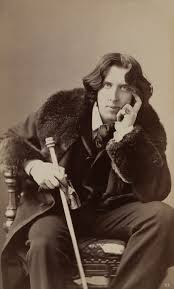
Oscar Wilde

In the Second World War, genius mathematician Alan Turing led a team of experts in cracking the Enigma Code, which was instrumental to the Allied success in winning the war. After the war, in 1952 Alan and his consensual partner, Arnold Murray were burgled, and in the ensuing investigation Alan admitted to the police the sexual nature of their relationship. Both Alan and Arnold were brought to trial, and due to Alan pleading guilty, he was offered a choice of imprisonment or probation, the latter conditional on him agreeing to chemical castration. The result of the hormone treatment, the lack of freedom to continue his work (his security clearance was revoked due to his criminal record), and various other factors all related to his conviction, all impacted his mental health, and in 1954 Alan Turing was found dead in his home, by his housekeeper. An inquest found his death was suicide by cyanide poisoning.

Alan Turing, and the Turing Machine, 1936

The Wolfenden Report was published in 1957. It looked into the UK law relating to homosexual acts, and recommended that consensual acts of homosexuality, carried out in private, should no longer be criminalised. It was debated at length in parliament, in the media, in religious communities, and in the pubs of Lancaster, no doubt. But it wasn't until 1965 that the decriminalisation of male homosexual acts was proposed in the House of Lords. (Lesbian acts had never been illegal in the UK.) A year later, the same was proposed in the House of Commons, and finally the Sexual Offences Act was passed in 1967, which finally decriminalised consensual sex between two men, of or over the age of 21, in a private setting. There was still a long way to go for the winning of fair and equal rights of gay people, and those restrictions were over turned by the European Court of Human Rights in 2000.

Walter died in January 1966, at the age of 64. It was shortly after, that Kenyon sold up, and joined his younger sister Doris (aka Tia), and her family, in their move down south, to Goring Heath, Oxfordshire. The multi-generational family of Doris, her husband, and their 2 younger children, lived with her mother in law, and Kenyon. When Arthur Gardner died in the mid 60s, Lily, Kenyon's sister also joined the Goring gang; it must have been a fun home!

Kenyon passed away on the 1st February 1983, in Goring Heath. He was much loved by the family he left behind and those who knew him, and Walter remember them fondly.

It is my hope that in writing this we are able to honour the lives of Walter and Kenyon, and preserve their story, in a way in which the official written records cannot. 

With thanks to my father, his cousin Liz, and others (namely members of the Old Lancaster Pubs Facebook group) without whom I would not have been able to complete this story.

#Holding

************************************************

https://en.wikipedia.org/wiki/Oscar_Wilde#Imprisonment

https://en.wikipedia.org/wiki/Alan_Turing

https://en.wikipedia.org/wiki/LGBT_rights_in_the_United_Kingdom

https://maps.nls.uk/geo/explore/#zoom=14.0&lat=54.32891&lon=-2.74239&layers=117746211&b=1&o=100

https://maps.nls.uk/geo/explore/#zoom=13.0&lat=54.05026&lon=-2.79588&layers=117746211&b=1&o=100

https://www.orkney.com/things/history/wartime

Sunday, 28 April 2024

Love & Marriage; An Irregular Marriage

William Grosart and Margaret Shaw were my husband's 6x great grandparents. William Grosart was born in Borthwick, Midlothian, Scotland in 1752, and was baptised in the kirk there on 27th October 1752. Borthwick was very close to Temple, the parish that was to be involved with proving his marriage, 20 years after his birth. Temple is of course, famous for it's connection with the Knights Templar, and all the legends connected to the Holy Grail etc. William was one of six children born to Ebenezer Grozer and Jean Carter. It's not possible to work out when or where Margaret was born, nor who her parents were.

Borthwick Castle

Together William and Margaret had 9 children, the first of which was my husband's 5x great grandfather; Ebenezer Grozer (1772 - 1858). William and Margaret were married for 28 years. before William passed away in 1800, but there is no marriage certificate for them; not on Ancestry, Scotland's People, or in any archive. This is because their marriage was 'irregular'; the only record to be found of their union is in the Temple Kirk Sessions of 1772. So, before I tell the tale of their union, let me explain a little about 'irregular marriage'.

Temple Old Kirk is now in ruins.

In Scotland, in 1772 and for many other generations both before and after, marriage could be achieved both by regular means (being married by a priest, after banns had been read), or by irregular means. An irregular marriage could take a variety of forms, but all were equally legal, and were based around the idea of mutual consent.

One form of irregular marriage would today be considered as a 'common law' marriage. Marriage by cohabitation with habit and repute basically involved a man and woman living together, and behaving in all ways, as a married couple. Evidence for this kind of marriage might include the couple referring to each other as 'wife' or 'husband', and engaging in displays of affection. There was an assumption that if a couple had shown themselves as married for a reasonable length of time, consent for the marriage had been agreed.

A second form of irregular marriage was officially referred to as Per Verba de Futuro Subsequente Copula. This was an irregular marriage in the form of a promise to marry in the future, which would be followed at a later time, by 'carnal intercourse'. 

Due to the irregular marriage practice in Scotland, English couples, desirous of a quick marriage without questions,  would hasten to the famous blacksmith at Gretna Green.

The type of irregular marriage that William and Margaret were 'guilty' of, was the third type of irregular marriage; Per Verba de Praesenti. This was where a couple exchanged words of mutual consent to be married. This could be in a private, or informal setting, and would ideally be witnessed. An unwitnessed version of this type of marriage was considered legal, but was of course, harder to prove.

Prior to the mid 1500s all three forms of irregular marriage were common place throughout Europe. After the Council of Trent in 1563 however, the Roman Catholic Church banned all irregular types of marriage and determined that marriage would only be considered legal if conducted in front of a priest. Scotland resisted this change, on the militancy of the members of the lay kirk sessions. (Kirk is the Scottish term for church, and the session was a form of church court.)

The Ordination of Elders in a Scottish Kirk, John Henry Lorimer

Despite the desire to retain the choice of irregular marriage, it was important to the church parish to establish which marriages were true, and which were false. This was firstly, for the reason of morality; a system of discipline was enforced by the church courts, to ensure that all members of the parish were 'godly'. It was considered by the Church of Scotland, that godly discipline was a sign of the true church. It was believed that this godly discipline had to be a communal effort, for it to count in a spiritual sense. Additionally, the insistence that irregularly married couples appeared at the church courts was an effective way to assert authority. On purely practical level, the kirk needed to know who belonged to their parish, so they would know to whom to offer poor relief. If an irregular marriage could be proved then the children from that union would be supported by the husband's parish kirk. If however, the marriage could not be proved the children would need to seek assistance from the mother's parish kirk. A record of marriages, both regular and irregular, was necessary to the management of poor funds.

Irregular marriage was an attractive solution when marrying in a hurry was required, perhaps because a baby's birth was increasingly imminent, and it seems that this may have been the case for William and Margaret. By March or April of 1772 Margaret was probably aware that she was expecting, and the Temple Kirk session notes suggest that she and William claim to have been married in Edinburgh by consent, on January 23rd, 1772, ie before the conception of this child. They cited a Charles Johnson as witness to their irregular marriage. Apparently the lay members of the Temple kirk did not believe this story, and for whatever reason chose to pronounce that irregular marriage false. 

The Black Stool (Stool of Repentance) by David Allan

Perhaps William and Margaret expected the kirk to make this proclamation, because they chose to go ahead and make a second (or perhaps first) irregular marriage on the 29th August, 1772. Their case was heard at the Temple kirk sessions on the 20th September 1772.

TEMPLE KIRK SEPTEMBER 20TH 1772

(in margin; William Grozer & Margaret Shaw compear before the session & confess their irregular marriage)
After prayer sederunt (a prolonged sitting) the session.
This day William Grozer and Margaret Shaw (in consequence of a citation formerly intimated to them) attended the session and being called compeared (appeared at the session) and being interrogate as to their irregular marriage produced lines (records) for the same dated at Edinburgh January 23rd 1772 and subscribed by one Charles Johnson. But the falsehood of this pretended date being immediately detected and the true date of their marriage discovered to have been upon the 29th of August last for which dissimilation they were sharply rebuked by the minister as also for their irregular conduct relative to their marriage and after (they being declared married) were recommended to the study of sound and unfeigned repentance and a more orderly course of life for the future and so for this time dismissed. The session concluded with prayer.

We will never know if William and Margaret's January irregular marriage was true or not. Irregular marriages are troublesome for genealogists due to their lack of record. But it is interesting to me that the supposed story of being irregularly married in January would make a pregnancy conceived in February legitimate. Nevertheless, they were 'properly' married in August, when she was 6 months pregnant (assuming the baby was born at full term), and 7 months pregnant when the couple were admonished, and sentenced to repentance and prayer. Just two months after the hearing at the Temple Kirk session William and Margaret's first child was born; Ebenezer Grozer. 

William and Margaret went on to have 8 other children. William Grozer died on the 8th May 1800, and Margaret died on the 2nd February, 1821. They were both laid to rest in Colinton, Midlothian, Scotland.

The villlage of Colinton, in the 19th century

From the 1st January 1855 all marriages in Scotland were required to be registered, but the system of irregular marriage in Scotland continued until 1939, when it was finally overturned in favour of either a marriage conducted by a minister, or by a registrar. 
A Highland Wedding, David Allan
William and Margaret were certainly married, as the Temple Kirk session proved, even if it was irregular. Since there is no way of proving love, one can only hope at that. Nine children certainly does hint that there was more than a touch of love! #Grosset

**********************************************

https://www.nationalgalleries.org/art-and-artists/9643/borthwick-castle

https://www.scotlandspeople.gov.uk/article/irregular-marriage-and-kirk-session-scotland

https://academic.oup.com/jsh/article/47/2/507/1325355

https://templemcp.wixsite.com/mysite

https://www.nationalgalleries.org/art-and-artists/8323/black-stool-stool-repentance

https://www.legacy-quest.com/post/scotland-s-kirk-session-records-a-hidden-gem

https://www.scotsman.com/news/opinion/columnists/despite-kirks-disapproval-scotlands-long-tradition-of-irregular-marriage-proved-remarkably-resilient-susan-morrison-4460665

https://www.jstor.org/stable/24532010

https://www.scotlandspeople.gov.uk/guides/record-guides/kirk-session-records


Thursday, 18 April 2024

Step; Step Parents, Birth Parents, or Adoptive Parents?

Over recent blog posts I have described the lives of my great grandfather, William Nicholson Edgill, and his three older siblings, Nanna Nicholson Edgill, Florence Nicholson Edgill, and Etholwyn Nicholson Edgill. I have always been intrigued by these four siblings, as I have never been able to find any birth records for the four of them, and they were all baptised as adults at the age of 17 (Nanna & Etholwyn), and 15 (Florence & William). I've also been completely unable to find any of them in the 1871 census, nor their 'mother' Hannah Standring. The four of them just seemed to appear out of thin air, after Hannah and William's marriage, in September 1872, and in the 1881 census. Where were they all in 1871, and who really were their birth parents?

Some other amateur genealogists on Ancestry have decided that Elizabeth Hague, William Nicholson Edgill's first wife, was the mother of the children; I think soley because she was his wife at the time. To explain the mystery a little better I think it's best that I write this post in the form of an outline of William Nicholson Edgill and his family life. (His professional life was also VERY interesting, but that can wait for a different blog post!) In an effort to make things as simple as possible I shall refer to William Nicholson Edgill, the father, as William Nicholson senior, and William Nicholson Edgill, the son, as William Nicholson junior.

William Nicholson Edgill (senior) was born in Sheffield, in 1821. He married Elizabeth Hague in 1846, in Sheffield, when he was working as a merchant's clerk. William and Elizabeth had a total of 10 children together. Their first two children were born while the family were still living in Sheffield; Tom Nicholson born in 1848, and John William born in 1850. When the 1851 census was taken William Nicholson (senior) was recorded as working as an accountancy clerk, in Manchester. 

1851 Census- Southall Street is a road that now runs the edge of HM Prison Strangeways

Later in 1851 they welcomed their third child, another boy, named William, born at the same address in Cheetham, Lancashire. In the following seven years the couple had 3 more children; Joseph Ashley (1853), Mary Jane (1855), and Harriett (1856). In 1858 William Nicholson (senior) took the post of clerk to the Guardians at the Chorlton Poor Law Union, and their daughter Elizabeth was born. Another son, Harry Rawson was born in 1860, and the 1861 census shows the family of 10 (2 parents and 8 children) all living together on Queens Terrace, Withington Road, Moss Side. 

1861 Census- an additional maid in the household suggests a certain level of wealth

In the same census, just down the road, at Marlborough Place, Withington Road, Moss Side Hannah Standring (his future second wife) was living with her widowed father, siblings, and 3 year old cousin. The last two children that I am certain were birthed by Elizabeth were Charlotte Justina, born in 1862, and Jessica Francis, born in 1865.

Elizabeth was 44 years old (close to the end of her child bearing years) when Jessica was born, on the 27th February 1865. The oldest of the 4 'mystery' siblings, Nanna, was born on the 10th May, 1865. It seems clear that based on these two close, but not close enough for twins, birth dates Elizabeth could not possibly be Nanna's mother. The other three siblings were born in 1867 (Florence), 1869 (Etholwyn), and in July 1871 (William Nicholson junior). 

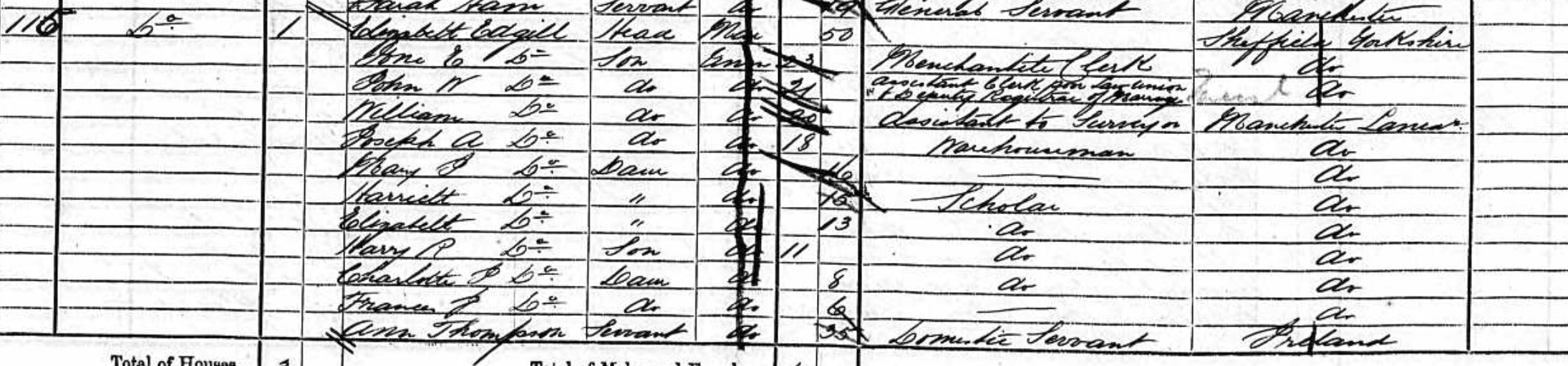
In the 1871 census Elizabeth Hague was living with her ten children, and a servant, by the name of Ann Thompson. William, her husband was not at home, at that time. He was visiting his dad in Sheffield. This does not signal that something nefarious or illicit was going on. The census recorded anyone staying at the home on that day/night. William was most likely simply visiting his father, John Edgill, who was 80 years old at the time the census was taken. What is frustrating however, is that I've found it impossible to find Hannah Standring, William's second wife, and 3 of the 4 children in question at all in 1871. (The census was taken in April 1871, and William Nicholson junior wasn't born till July 1871.) A decade before, in 1861, Hannah was down the road, and in 1871 she had apparently disappeared! The 3 children seem to have not existed officially until the 1881 census!

1871 Census- note son John was working as assistant clerk to his father

Elizabeth Hague died the following year, from tuberculosis, on the 6th July, 1872. She could have been the mother of my great great grandfather William Nicholson junior. She was alive at the time. But she was 50 years old, and possibly sick with tuberculosis which would later claim her life. She also already had a child named William, and it seems unlikely that the parents would use the same name twice, when the older brother was still living.

Just 2 months after Elizabeth's pasing, on the 10th September 1872, William Nicholson Edgill (senior) married Hannah Standring at the Liverpool register office. Such a swift second marriage of a husband, after a wife's death was not uncommon at the time, especially when there were so many children for whom to be cared. But it is interesting to me that they were married in Liverpool, and not somewhere in the Manchester area. As the superintendent registrar for Chorlton he could have easily arranged for them to be married locally. Perhaps there was a desire to keep the marriage quiet....? Of course, we can't know their reason, but it sure is frustrating not knowing!


In the following census of 1881 the large blended family were recorded as living together, with a few missing people. This is the first time that we see the 4 siblings in question recorded; finally they officially exist! Along with William senior and his new wife Hannah we see 4 of Elizabeth's children still in the home; Elizabeth, Harry, Charlotte, and Francis. 

1881 Census

Since Elizabeth's death the family had experienced a series of tragic losses. Tom Nicholson Edgill had left England and gone to work in Sierra Leone as a mercantile clerk. The adventure to Africa came to an abrupt end when the bachelor died in 1877, in Madeira. William Edgill (the son born to Elizabeth Hague in 1851) and sister Mary Jane both died in 1879; more victims of tuberculosis. William died in April, and Mary in July. It must have been a tragically hard year for the family.

Phthisis Pulmonaris was the medical term used then, for pulmonary tuberculosis.

I believe that Mary died in the home where her sister Harriet lived with farmer husband, Peter Fletcher. It would be common in Victorian times, for the affluent, sickened by TB, or consumption, to seek cleaner, country air. A family farm would be the perfect escape from city air.

Over the years there had also been reasons for celebration, with marriages, and the births of more children and grandchildren for William Nicholson Edgill senior. In 1876 Joseph Ashley Edgill married Mary Bamford, a school mistress, and daughter of a glass manufacturer, William Bamford. By the time of the 1881 census Joseph Ashley was living at 1 Thurloe Street, Rusholme, just south of the family's neighbourhood of Chorlton on Medlock, with his wife Mary, and son William Bamford Edgill. 

John William Edgill married a Scottish lass, named Elizabeth. In the 1881 census they were living together, with their daughter Amy Elizabeth, an Irish servant by the name of Bridget Read, and a boarder, and possibly a relative of step mother Hannah, called Edward Standring.

Harriett Edgill married a farmer named Peter Fletcher in 1878, in Hulme, Manchester. His farmland was in Woodhouses, Dunham Massey. By the time of the 1881 census they had two daughters together; Jessica, and Ann Catherine.

William and Hannah had also been busy in the years since their marriage. Three new children were born to them in those 9 years; James Standring Nicholson Edgill, born in 1874, Mary Beatrice Edgill, born in 1875, and finally baby Agnes Hilda Violet Edgill, born in 1880.

The 1881 Census also recorded, living with William Nicholson senior, and wife Hannah these 4 new children;
Nanna Nicholson Edgill, born in 1865, in Bowdon, Cheshire
Florence Nicholson Edgill, born in 1867, in Liverpool, Lancashire
Etholwyn Nicholson Edgill, born in 1869, in Stockport, Cheshire
William Nicholson Edgill, born in 1871, in Romiley, Cheshire.

I believe that it was here, at Rose Bank, Gibraltar Lane, that William Nicholson Edgill junior, was born, or spent his first few years. Further down the lane, behind the photographer, was a row of mill worker cottages, and the Gibraltar Mill. In later census reports William gave 'Gibraltar, Cheshire', as his place of birth. And directory entries for his father gave the address of Rose Bank, Haughton Dale, which is where the Gibraltar Mill was situated. It's fun to imagine that these children might have been ancestors.

I find it so curious that these children all have such  different places of birth. If they were Hannah's children, she must have moved around a lot in just 6 years! If they were Elizabeth's children, where were they all in 1871? Since we know that Elizabeth had tuberculosis, which can be transmitted to a fetus in utero, could they have been born sickly, and were sent as babies, to be cared for in cleaner air than that afforded to them in Chorlton? If that was the case, I should still have been able to find them in census records. 

An alternative theory is related somewhat to William Nicholson senior's job. He worked as a clerk to the Guardians of the Chorlton Union; the workhouse. In this role William would have been well aware of the needs of the people depending on the poor law union's facilities. He would also have been aware, and perhaps involved in the various work that the union was doing to improve those facilities, and other charitable works being carried out in the Manchester area. There was a great need to support orphaned children in Manchester at this time, as was common throughout England. This was an era of dangerous industrial work, where a lack of health and safety in the workplace was commonplace. It was also a 'pre penicillin' time, and an era where vaccinations were uncommon. Diseases such as the measles, scarlet fever, and tuberculosis were so common and deadly, leaving a large number of children orphaned and in need of care by whatever means society could offer. The charitable people of Manchester were active in their efforts to help these children. In 1854 a group of Manchester businessmen founded a school for the orphaned children of warehousemen and clerks, called "The Manchester District Schools for Orphans and Necessitous Children of Warehousemen and Clerks". The school was (and still is) located in Cheadle Hulme. Warehousemen and clerks in the city were invited to pay a small subscription, and in return their children were promised care, shelter, and an education, even if they were orphaned. The orphans attending the school slept in dormitories at the school, whilst fee paying students whose parents still lived, attended as day students. 

The school is now an independent (private) school, and was renamed Cheadle Hulme School.

Meanwhile in Chorlton, the board of Guardians recognised that there was a need for child specific housing, and in 1880 developed a children's orphanage and school across the road from the workhouse, which housed at least 271 children of school age, plus 70 infants. 

Considering William Nicholson senior's job as a clerk, and the number of children he had who also became clerks, and spent time working as warehousemen, it occurred to me that he could have had a connection to the school. Perhaps he paid a subscription so he could be confident that his many children would be cared for, if he died before they were all of age. It also occurred to me that in his work at Chorlton Union he and Hannah may have decided to move their charitable acts into the family home, and adopted the 4 children. This would conveniently explain their various birth places, since they could potentially have different birth parents. There is no way of telling if they had adopted Nanna, Florence, Etholwyn, and William junior. Adoption records were not kept at that time, and was done on purely an informal arrangement. 
Sadly, the baby of the family Agnes Hilda Violet had died, aged 2, of scarlet fever in 1882. I have not been able to find any record of her ever having been baptised, which, if she was not, was uncommon for the time. Interestingly, the only record we have that suggests the birth dates of the 4 siblings in question, are their baptismal records, all of which happened after Agnes' death. They were baptised in pairs, as teenagers, with Nanna and Florence being baptised together, in 1883, and Etholwyn and William junior being baptised in 1887. I have wondered at these late baptisms, and have pondered on whether they were a reaction to the unbaptised baby's death. 

Whilst it's clear that Hannah Standring was step-mother to the older children in the family, born to Elizabeth Hague, the records suggest that she cared for her step children, and they for her. In the death certificate for William (Elizabeth's son; see above), Hannah was named as the person who registered the death; she was present at his passing, and was recorded as 'mother'. After her husband William Nicholson senior's death in March 1891, Hannah continued to ensure all her children (step, birth, and possibly adopted) had a safe home in which to reside. In the 1891 census, taken the following month, adults Harry, Charlotte and Francis were living in the family home at Brunswick Lodge, 404 Moss Lane East, along with their step/adopted siblings Florence, Etholwyn, and William, and half siblings James and Mary Beatrice. 

1891 Census- The census was taken roughly 10 days after William Nicholson senior's death. Note that son Harry was working as the interim Superintendent Registrar, because it was so soon after his death that the board of guardians hadn't yet found a replacement for the position.

In ensuing census reports we see Hannah continuing to live with the children of her blended family. Sometime between the 1891 and 1901 censuses the family, somewhat reduced in size, moved from the large house on Moss Lane East, to a smaller terraced house on Sandy Lane, Chorlton-cum-Hardy. William Nicholson junior (my great grandfather) had moved to London, by this time, and was working and living in the hotel/restaurant/brothel 'The Golden Bells'. Harry Rawson Edgill (Elizabeth Hague's youngest son) sadly died in 1894; yet another tuberculosis victim.

Brunswick Lodge, 404 Moss Lane East, was the family home at the time of William's passing. It is now the Jaffaria Islamic Centre. (I have no idea who the man in the portrait photo was. He may have been an ancestor, or someone who lived in the house, after our ancestors moved out.)

Hannah lived on Sandy Lane, until her death, with step daughter Charlotte, possibly adopted daughter Florence, and daughter Mary Beatrice. She was named as head of the household in both 1901 and 1911, but in 1921 her daughter Mary Beatrice was named as head. I'm not sure if this is because the deeds of the house had been handed over to Mary, perhaps in an effort to escape any death duty, or if Hannah, in her late age, had lost the mental capacity to manage her own affairs. Either way, it does seem that, in her senior years, Hannah was being looked after by her step daughter Charlotte and her daughter Mary.

Manchester Evening News, Saturday August 6th, 1927

Mary Beatrice married widower Frederick William Bates, a pharmacist,  in 1925, and Hannah moved with her daughter, into their marital home at 2 Wellington Crescent, Darley Park, Stretford, Manchester. It was here that the mother to so many children in her large blended family, Hannah Standring died, at the grand old age of 90, in 1927.

Whether Hannah was a birth mother, adoptive mother, or step mother, perhaps isn't important. What is clear from the footprints she's left behind, in the records of her life, is that she was a mother. 


Monday, 15 April 2024

Taking Care of Business; International Velveteen Trade

'Taking Care of Business' is a writing prompt for mid May; the actual writing prompt for this week is 'Step'. I know what I want to write about for 'Step'; Hannah Standring, and the mystery of the 4 children she had prior to her marriage with my 2x great grandfather, William Nicholson Edgill. I have already written about three of those children; Florence Nicholson Edgill, Etholwyn Nicholson Edgill, and my great grandfather, William Nicholson Edgill. So before I tackle that tangle, I figured I would mix up the writing prompts a little and focus this week on their eldest sister; Nanna Nicholson Edgill.

Just as with her 3 younger siblings, I have not been able to find any birth record for her. She was baptised at the age of 18, with her younger sister Florence, on the 21st February, 1883, at St Paul's Withington, in Manchester. In the baptismal record her birth date was recorded as May 20th, 1865. The first time Nanna appeared in a census report was 1881, living with the large Edgill family at 77 Cecil Street, Chorlton-on-Medlock. Just as in her baptismal record, William Nicholson Edgill, clerk to the Guardians of the Chorlton Union, and superintendent registrar, was recorded as her father, and Hannah Edgill was recorded as her mother. At the age of 14 she was a scholar, and her birth place was recorded as Bowdon, Cheshire.

In early 1888 Nanna Nicholson Edgill married John Frederick Hithersay, in Chorlton, Lancashire. John was a velveteen manufacturer, with business on both sides of the Atlantic. John Frederick Hithersay was born in Manchester, in 1861, to John and Ellen Hithersay. John Hithersay (senior) was a lace manufacturer, and lace commission agent, from Ilkeston, Derbyshire. His father Benjamin Hithersay had also been a lace manufacturer. The Hithersays were a textile manufacturing family, with a focus on lace, making John Frederick Hithersay at least the third generation of textile manufacturers in the family, but the first to be manufacturing velveteen.

Victorian fashion demanded high quality, luxurious textiles, like lace, silk, and satin.


Velveteen, sometimes referred to as velveret, is a textile with a dense, short pile. It is different to velvet in that it is usually (but not alwayys) made from cotton, and has less sheen than velvet, due to it's pile being cut from weft threads, rather than the warp. Velveteen is a stiffer fabric, due to its shorter pile, and as a result has less drape than velvet. It is often used for upholstery, for fashion fabrics that are required to need stiffness and structure, and for the manufacture of toys, such as the famous Velveteen Rabbit, published in 1921.

It's an odd twist that the illustrator was named 'William Nicholson'!
No relation, as far as I know.

Whilst velveteen was usually made from cotton, this was not always the case. Obviously silk velveteen would be a more luxurious, and expensive fabric, than the cotton version. According to the 1891 Census of Englan and Wales John Frederick Hithersay was a manufacturer of silk velveteen. His interest in silk perhaps sprung from his work in the previous census (1881) when at the age of 19, he was working as a warehouseman for a silk manufacturer.

Nanna and John had two children together; two daughters, named Nanna Marjorie (born 1889) and Doris Standring (born 1890). Interestingly, in the 1891 census John and Nanna were recorded as living together with the 8 month old baby Doris, whilst the 2 year old Nanna was to be found living with her grandmother and various uncles and aunts, on a nearby street. I have a few theories as to why the child was not living with her parents, and new sister at this time, but none that I can prove.

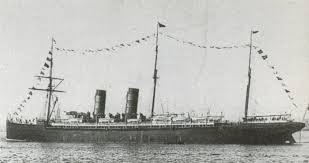
A year or so later it seems that John made his first journey across the pond. He took this first step in the family's American adventure alone. Leaving Liverpool on the RMS Umbria, he arrived in New York on 31st October 1892, ready to do business. 

RMS Umbria, on Queen Victoria's birthday, 1896.


John Hithersay was the owner, or perhaps co owner, of a firm named 'Hithersay and Ramm', however I have not been able to find out anymore about his supposed partner, Ramm. The company held a trademark in the USA for the use of the term 'velveteens', and I have found records of the company having paid US taxes, but I have found no other record of the business. Meanwhile UK trade directories included references to Hithersay & Ramm, velveteen manufacturer, suggesting that his company was working an  international trade in velveteen.

,John was to make several other voyages to the USA, over the following years. Sadly, between his comings and goings, the family was to manage a great loss. Nanna, their eldest daughter died at the age of 4, on the 2nd June, 1893. She had 'tubercular meningitis' and died after 12 days of illness. She was buried 3 days later at St Paul's, Withington.


Despite this loss, or perhaps because of it, John and Nanna took the big step to move their small family to the USA. The US Federal Census of 1900 shows that they arrived to settle in the USA in 1895. In 1900 they were living at 189 Woodworth Ave, Yonkers, New York. They were still living in Brooklyn in 1905, according to the 1905 New York state census. But the family apparently moved to Summit, in New Jersey sometime later.

The Summit High School is probably where Doris went to school, during their time in the city.


Presumably business was doing so well, that John and Nanna were able to afford a family visit back to the UK. In December 1907 the family of 3 travelled from New York, to Liverpool, on the RMS Lusitanisa; the same ship that was famously sank by German torpedoes in 1915. After spending the holidays and the rest of the winter in Manchester, they returned on the SS Lucania (a winner of the famous Blue Ribband) from Liverpool, which departed on the 29th February, 1908. They travelled both ways in saloon class, which gives an indication of the wealth that the family were able to enjoy, and arrived in New York just a week later on the 7th March 1908. 

The first class dining saloon, on the Lusitania.

Sadly, this international life was to come to an abrupt end. John Frederick Hithersay died suddenly, at his home in Summit, New Jersey, just a few weeks after their return, on the 25th March, 1908. His obituary included the address of his place of work, which was situated in a beautiful building, in the heart of Yonkers, New York, near the neighbourhood now known as Soho. 

New York Times, 26th March, 1908


According to John's last will and testament, Nanna inherited his entire estate, and less than a year later,  Nanna took care of the family business. Once again the family was to cross the Atlantic in a cloud of grief. Nanna and Doris, travelled home to the UK on the RMS Baltic, in First Class, arriving in Liverpool on 3rd April, 1909. 


Mother and daughter settled in the Peak District initially. The 1911 Census of England and Wales recorded them living together, on their own means, in Chapel-en-le-Frith, Derbyshire. Her brother in law, lace and net merchant Herbert Hithersay was living just south of them in Buxton at the time. Within the next decade mother and daughter made another move, to St Anne's-on-Sea, just south of Blackpool, where Doris was 'school principal' and 'employer' for Norland House School. They had two pupils (aged between 5-7 years old) living with them. I've found no record of the school, and can't say if it was just those two students they had enrolled, or if there were more day students.


Shortly after the 1921 Census Doris met and married a widower by the name of Russell Stockton. Russell was an architect who worked for the Corporation of Manchester. (Later, during the war, Russell was to engage in civil defence work, under the direction of the city's architectural department.)

Nanna passed away in 1929, in St Anne's-on-Sea, and was buried on the 12th September 1829, in the Southern Cemetery, Chorlton-cum-Hardy, where the lives of her husband, John Frederick Hithersay, and daughter Nanna Marjorie Hithersay were also commemorated. Russell and Doris both passed away in their early 60s, in 1948 and 1951 respectively. 


Whilst I'm not entirely sure what ultimately became of the velveteen company, Hithersay and Ramm, I do know that it continued trading for sometime after John's death. I have found mention of it in The City Record (for New York) of 1931. I have wondered if the company continued under the control of the elusive Ramm.

Now I have introduced all four of the siblings for whom I have so many questions, I hope to, in my next blog post, pose those questions and offer some answers.

#Edgill

*****************************************

https://www.facebook.com/PreservingTheRMSLusitania/photos

https://en.wikipedia.org/wiki/RMS_Umbria

https://greenerpasture.com/Places/Details/636

https://en.wikipedia.org/wiki/RMS_Baltic_%281903%29

http://cityrecord.engineering.nyu.edu/data/1931/1931-06-10%20part%200005.pdf

https://en.wikipedia.org/wiki/The_Velveteen_Rabbit

https://en.wikipedia.org/wiki/Velveteen


Wednesday, 10 April 2024

School Days; Styal Cottage Homes

I had thought that I would sit this week out, since I didn't think I had any school stories in my ancestry. Instead of putting together a blog post, I decided to work on the Edgill branch of my family; the first part of my family history that I researched, many moons ago. I started on rechecking my original research, and looking through any new records that were now available online. It was while I was doing this work that I stumbled upon the perfect story for this week's writing prompt, from #52Ancestors. 

Etholwyn (sometimes spelled Ethelwyn) Nicholson Edgill was my great grandfather's sister. She was born, according to her adult baptismal record, on 4th July 1869, in Stockport, Cheshire. Just like her older siblings, and like my great grandfather, I've not been able to locate her in the 1871 census, and have not found any birth record for her, so cannot confirm her parentage. She does, however, appear in the 1881 census, where her parents were recorded as Hannah Standring and William Nicholson Edgill, the clerk to the guardians of the Chorlton Poor Law Union, and superintendent registrar. She lived at home with her family in the 1891 census, but by 1901 Etholwyn was no longer living at home.

With such an interesting name it was fairly easy to find Etholwyn in the 1901 Census, living as a boarder with Henrietta Jane MacMillan, on Hawthorne Grove, Wilmslow, Cheshire. Henrietta was the Head Mistress at the Styal Cottage Homes, and Etholwyn was her assistant. The record was poorly written, and I thought it must have been a misspelled word; Styal seemed an unlikely name. I googled "Styal Cottage Homes" and would you believe? It was a real place!!

The entrance, gateway, and lodge.

Styal Cottage Homes was built by the Chorlton Poor Law Union (the same union for whom Etholwyn's father had worked) at the turn of the century, to house destitute children from the Chorlton/Manchester area. It was a forward thinking endeavour, where not just a traditional orphanage was created, but an entire village consisting of 12 cottage homes, each with 20 beds, 4 smaller homes, each with 10 beds, plus a church, a hospital, and a school. Building work started in 1896, and was mostly completed by 1903, although some additional buildings were added in 1905, and 1928, which included a farm, used as an agricultural training school. 

The school at Styal Cottage Homes

Children lived in the village in one of the 'cottage' homes, which were actually quite large houses. Each 'cottage' had a house mother, and assistant house mother, and there were other staff, of course, to run the school, hospital, and other facilities, obviously including a head mistress and her assistant! All in all the population of Styal Cottage Homes village was approximately 310, when it opened in 1898, but would have capacity to accommodate 500-600 staff and students.

Prior to the creation of Styal Cottage Homes the orphaned and destitute children of Chorlton had been housed at first in the workhouse, along with the adults. In 1880, in an attempt to do better for the children, the Chorlton Union built new schools and a children's home across the road from the workhouse, on Nell Lane, Chorlton. The homes consisted of two 6 storey buildings, one for the boys and the other for the girls. They were connected by a single storey block which housed the dining hall, laundry and such like. The school was to the north of these buildings, and formed the entrance to the overall site. This allowed the guardians to move 271 children, and 70 infants out of the workhouse, making room for 200 adults to take their place.

Nell Lane School and Orphanage, designed by architects Mangnall & Littlewoods, in 1880.

Styal Cottage Homes was an idea that sprang from a desire to do better for the destitute and orphaned children in the Chorlton Union workhouse. It was felt that the country air would be beneficial for them, and the village community aspect was very en vogue for the time.

The industrial era had many examples of mill and factory owners building workers accommodation in a model village style. Bourneville is one famous example of such an endeavour, where the Quaker Cadbury family built a model village for the workers of their Cadbury chocolate factory. The idea behind model villages was partly rooted in the need to attract labourers to a part of the country where there was little accommodation, but where the land was ideal for a mill (often with a good head of water for a source of power.) But it was also rooted in the Victorian principles of morality, and health.


Most model villages came, not just with a job and a nice home, but also conditions regarding how a worker and resident should live. In Bourneville, for instance, the sale of alcohol within the village was strictly forbidden. Textile mill owner Titus Salt developed a model village in Yorkshire, named Saltaire. His rules included the prohibition of hanging out laundry to dry, the prohibition of any animals being kept in the village, and insisting that cleanliness, cheerfulness, and order should reign supreme, to name but three. Imagine having a condition of housing that insisted that you be constantly cheerful!!

Saltaire is now a World Heritage site.

Styal already possessed such a model village, built and maintained by the Gregg family who owned and ran the Quarry Bank mill. They built what is now called the Styal Estate in 1784, so by the time the Chorlton Union was building Styal Cottage Homes, the philosophy regarding model villages was well understood, and ready to be extrapolated to fit an orphanage model. 

Quarry Bank, now known as the Styal Estate, was gifted to the National Trust in 1939.

Whilst we might imagine a village of, and for children, as a sort of adventurous child utopia, it seems like the reality was closer to prison life. The windows of the houses in which the children lived were all clearly visible from the street, whilst the superintendent's house was shielded by shrubs, bushes and trees. The school had a beautiful playground for the children to use at recess, which was contained by a wall, railings, and wrought iron gate. This was not to protect the children from unwanted visitors; there would be none such people within the village grounds. It was instead, to stop the children from using the playground outside  of school hours, which was strictly prohibited. Church attendance was mandatory, but only Anglican children were accepted. Catholic children were sent elsewhere. As with the model villages developed for working people of the industrial era, Styal Cottage Homes was designed to ensure that control over the children was constantly maintained, and that the children were upheld to the highest standards of morality, common to Victorian society.

An unusual subject for a picture postcard!

Etholwyn worked at Styal Cottage Homes for over a decade. She was recorded as working as an assistant to the head school mistress, Henrietta J MacMillan in 1901, and again in 1911. At both times they were living together, away from the Styal campus, at River Views, Hawthorne Grove, Wilmslow, Cheshire. It's not clear what work Etholwyn would have undertaken; secretarial, or teaching assistant type work or perhaps a mix of the two. But when I saw this picture, and the date, I imagined that she would have known these children!

Styal Nursery children, circa 1908.

Etholwyn married late in life (for the era) in 1916. On June 10th of that year she married Arthur Howard Davies, a solicitor, and widower, at St Clement's, Chorlton- cum- Hardy, Lancashire, close to her family home. Her mother Hannah Edgill, and her roommate, and colleague from her days at Styal Cottage Homes, Henrietta Jane MacMillan, were witnesses. Both Etholwyn and Arthur were 46 years old. Etholwyn never had any children and died at the age of 75, on 11th September 1944, at Chester Nursing Home, Chester, Cheshire. 

As for Styal Cottage Homes; the village was taken over by the Manchester Education Committee in 1930, and was used by them for a number of years as an outdoor school. Children were often sent to school there for residential schooling if they were unwell from the effects of city living (asthma, for example). Styal Open Air School eventually closed on the 20th July 1956. The village was used to house Hungarian refugees from December 1956- September 1959, and in 1960 the Prison Commission took over the site. The buildings now form part of HM Prison Styal, a closed category women's prison.

This modern day aerial view of HM Prison Styal,
shows that the original village layout is still visible.

#Edgill

**************************************************************

https://www.workhouses.org.uk/Chorlton/

https://en.wikipedia.org/wiki/Styal_Cottage_Homes

https://www.wilmslow.org.uk/wilmslow/styal-cottage-homes/styalcottagehomes.html

https://pure.manchester.ac.uk/ws/portalfiles/portal/54517312/FULL_TEXT.PDF

https://en.wikipedia.org/wiki/Bournville#Governance

https://en.wikipedia.org/wiki/Quarry_Bank_Mill

https://en.wikipedia.org/wiki/Saltaire


In the Beginning; How My Genealogy Journey Started

Back in 2016, on New Year's Day, my mother mentioned how October 2015 had marked what would have been the 100 birthday of her mother, my...