Sunday, 4 August 2024

End of the Line; The Mystery Letter

A while back, in my piece about nicknames, I mentioned a mysterious letter I found, almost a year ago to the day, in a folder full of paperwork and photos. The letter was dated 18th May 1922, and apparently came from a person by the name of Lilly, who lived in Yarmouth, Nova Scotia, Canada. My mother and I were unfamiliar with most of the names mentioned in the letter, and were oblivious as to who the recipient 'little scotch mother' was. I made it my mission to find out, and thus began the activity of unravelling the mystery only to find quite a knot in this branch of the family.

The letter, as it turned out, was from an Henriette Svenningsen, who was born in Denmark in 1879, to Ove and Julia Svenningsen. Sometime between 1895 and 1900, as a teen or young adult, Henriette and her family moved to the USA, and settled in Boston, MA. On the 20th September 1902 she married Liston Clark Newell, the younger brother of my great grandfather, George Edward Newell (aka Ted). 

Liston, like so many of that part of my family, including father Frederick, and brother George/Ted, was a mariner. He had trained with the British Merchant Navy, and had sailed over to the USA, from his home in Edinburgh, where there was extended family on his father Frederick's side (Frederick was from Framingham, MA). Liston worked on the Boston, MA to Yarmouth, NS steamer service, for the Yarmouth Steam Ship Company, and they lived in Yarmouth, Nova Scotia, where they raised their daughter Julia. Julia was born in Boston, MA before her parents were married, in 1900. I have often wondered at this, as such a thing would have been quite scandalous for people of their class in that era. Perhaps that is one of the reasons for their move to Nova Scotia; to escape the gossips. Alas, the women of this family were fated to dole out gossip in large amounts, to the small town of Yarmouth, NS.


As the Great War started in 1914, Liston switched from merchant navy to Royal Navy, and was given the rank of chief engineer. In the October of 1915 Liston was assigned to a ship named SS Dunelm, which was harboured in Halifax. The ship was take a cargo of scrap metal to the UK; the scrap would be useful to the war effort and was to be used to make weapons and ammunition. SS Dunelm was not designed for ocean travel, and was meant for use on lakes and rivers. Nevertheless, it was loaded up; it has been suggested, possibly with more cargo than was safe. The ship left Halifax in early October 1915, and was last sighted off the coast of Newfoundland on the 17th October. It is not known what happened to the steamship. German U Boats were not active in that part of the ocean at the time, so it's unlikely that it was torpedoed by the enemy. No icebergs were sighted at that time either. It is thought that the overloaded ship, that was not designed for ocean travel, hit poor weather, and the weight of the cargo shifted, causing it to overturn. No crew or wreckage was ever found. 

Liston C Newell is remembered at the Halifax Memorial, where his name can be found on Panel 3.

The letter from Henriette (aka Lilly) is to her mother in law, Liston's mother; Christina Hall Newell (aka Little Scotch Mother). In the letter Lilly talks about the death of Liston, and how hard life was for her and her daughter, who she names as 'Mussa'. It seems that this nickname might spring from the Danish word 'mus' meaning mouse. Perhaps Julia was a quiet, timid child, or maybe she had mousy brown hair.

Later in the letter, Lilly explains how she has remarried, this time to a doctor, who also signs the letter, with the name 'A R Campbell'. On researching their marriage I discovered that this doctor's full name was Alexander Rae Campbell. He was born in Noel, Hants County, NS in 1888, to presbyterian minister, Alex, and Bessie Campbell. Alexander Rae Campbell (aka Doc) was one of three sons, one of whom was a minister, like their father. Lilly was very proud of her marriage to this high status professional 'Doc', but this union was not to last. It seemed like an unlikely union. At the time of their marriage Lilly was 42, and Doc was 33. Sometime between 1922 and 1927 Lilly and Doc divorced, and (I have to say I was shocked to discover this) Doc married the sweet little Mussa on the 24th March 1927. That's right! Julia Newell married her mother's ex-husband!

Alexander Rae Campbell is pictured here on the right, with his parents and brothers.

What is somewhat more surprising is that the three of them continued to live together in the same house. In the 1931 Census of Canada the relatively newly married couple, Alexander Rae and Julia Theodora Campbell were living at 90 Parade Street, Yarmouth, NS with Lily Henrietta Newell (who had reverted to using the married name of her first husband, Liston) as the head of the household. Lily Henrietta was recorded as 'divorced' while her ex-husband (now recorded as her son-in-law) was recorded as married. The house in which the 3 of them were living had 20 rooms, I had at first thought that perhaps this made it easier for them to maintain a distance without creating too much tension. In my exploration of this branch of the family I found a Yarmouth native who had known Julia and her mother. They had lived nearby and visited with Julia in her later years. Julia had apparently admitted that the house, being so very big, was very expensive to heat, and so the three of them lived most of the year in just the kitchen, where the heat could be maintained without costing too much money.

The home on Parade Street, where Lily, Mussa, and Doc lived is now home to the Yarmouth Lions Club.

However fraught their union might have been at the start, 'Doc' and 'Mussa' lived an apparently happy life together, and went on to have two sons; Alexander Newell Campbell (known to his family and friends as 'Sandy'), and Peter Albert Campbell. 'Doc'  died in 1940, at the age of 51. He was buried at Castle Hill Cemetery, in Pictou, NS in the spring of 1940. 

Obituary for 'Doc' who was a recipient of the Military Cross for his work in WWI.

Julia continued to live at Parade Street, Yarmouth, NS until her death in 1962. She was buried at Yarmouth Mountain Cemetery, Yarmouth, NS. It's not clear to me where or when Lily/Henriette died. She was living with Julia up until at least 1953, when they were both in the electoral register at the same address, and both using the last name 'Campbell'. For a moment, in my research, I thought perhaps that Lily had changed her names to Theodora Newell, using her daughter's middle name, and her first married name. I kept turning up records for a Mrs Theodora Newell, widow, from Atwood's Brook, a municipality of NS, about an hour south of Yarmouth. On closer inspection, however, it seems unlikely; the family name 'Newell' was quite common in that part of the principality, and Theodora was a relatively common name for the age.

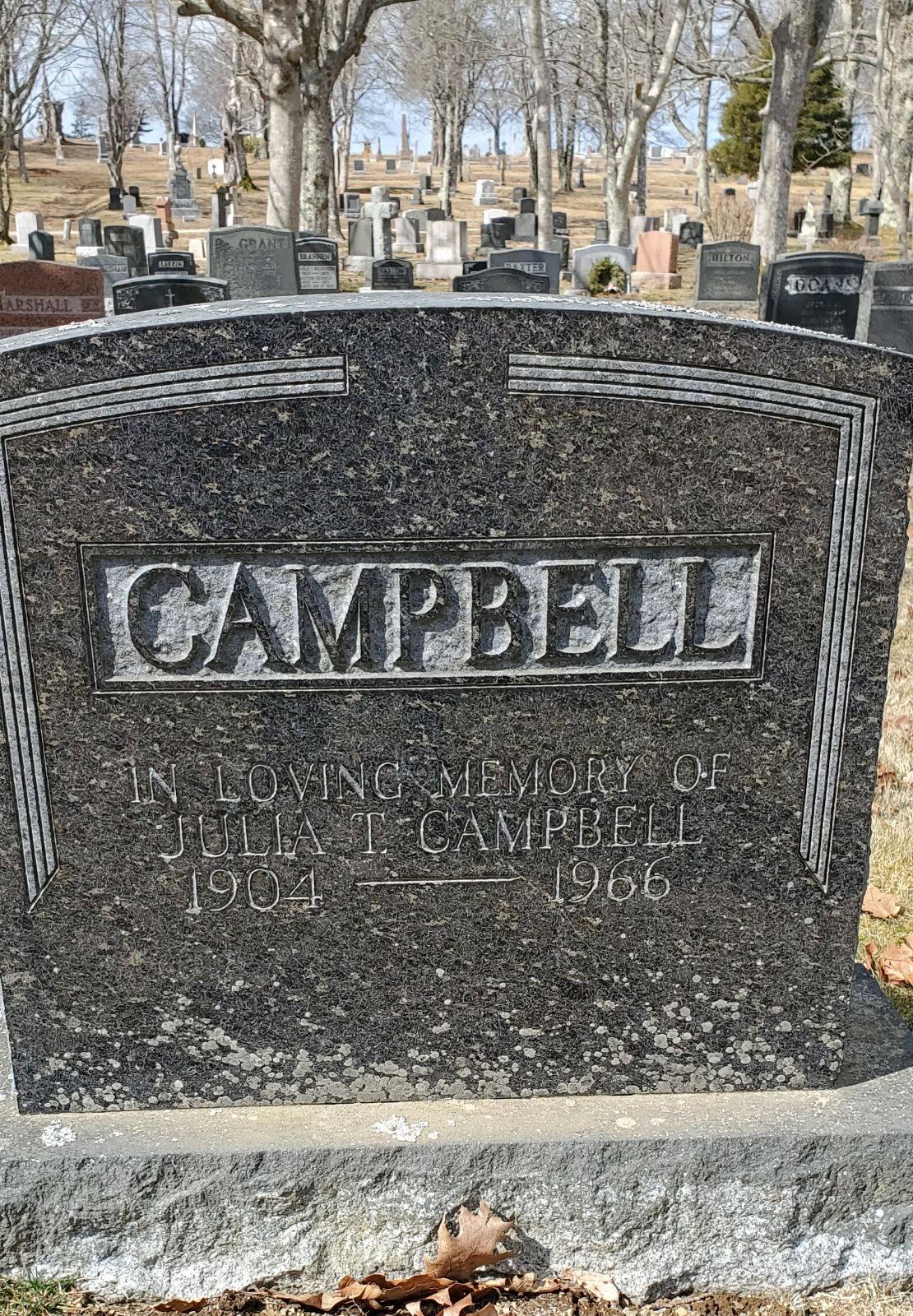
Whilst Julia's grave gives her birth date as 1904, other documents suggest her birth was closer to 1900/01. No reliable birth record has yet been found.

When I first discovered that Julia and Alexander had children, who would have been cousins to my mother, I was a little excited. We've been living in Canada now, for about 18 years and all our family are in the UK and mainland Europe. If Sandy and Peter had children I might have distant relatives in this new world; how fun would that be!?! Alas, and alackaday- it was not to be so.

I have not been able to find any reliable life records for Sandy, but the obituary for Peter Albert Campbell stated that he 'was the last surviving member of his immediate family.' This suggests to me that Sandy had passed away without issue too, meaning that, for this branch of the family, it is the end of the line.

Peter Albert Campbell's obituary.

Or is it? Today, while tidying up the last few bits for this blog I discovered a tree on Ancestry, that I'd never seen before. It includes 'Sandy', Peter, and their parents, Julia and Alexander. It also includes a spouse, and two children, all of whom are still living, and so details are unavailable to me. I have messaged the tree owner, and wait with curiosity! Maybe I do have some living Canadian cousins, after all!

And that is where this story ends, or does it?

To see the letter in full, and to read my research notes about it, and the people written about, please follow this link.

#Newell

*********************************************

https://www.hmdb.org/m.asp?m=112166


Friday, 2 August 2024

Boats; Captain George Newell, A Voyage- Part I

As I was recently working on my Newell branch, I stumbled upon a reference to a book named 'Two Brothers' which was a transcript of the 1850-51 logbook of Captain George Newell, my 3x great grandfather. George Newell was born in Sherborn, Middlesex county, in the state of Massachusetts, in 1791. He was the son of Thomas Newell and Polly Phipps, and the second eldest of 9 children in total. His youngest brother was Fisher Ames Newell, who was born in 1808, when George was 17 years old. Despite their distance in age, it appears that they were relatively close.

I started a  search for the book, and discovered that one of my local universities had the book in digital form, for members of their library to access. I turned to a friend, who works at that university, and they were able to help me access the book. Success; I could read about how my 3x great grandfather spent his time from February to 1850, to March 1851!!

The logbook charts the progress of Captain George Newell in the bark named 'Sea Breeze', as he travelled from his home port of Boston, MA, to San Fransisco, Honolulu, Canton, and home via NYC. Most of his entries whilst sailing from one port to the next are fairly dull, and speak of wind directions, weather, and ships they passed along the way. But there are many interesting tidbits of information caught in between, which I thought I would include in this, and a couple of further blog pieces.

Captain George Newell departed from Boston on the 8th February, 1850. By 6am on the 8th March the barque, Sea Breeze had passed the equator;

'The Equator was passed this morning about 6 o'clock and the green ones congratulated themselves on not having received the customary visit from Old Neptune.'

There was, and still in in some places, a tradition when crossing the equator, to use the milestone as an initiation rite for new hands who had never done so before. Names were given to those who had already passed the Equator; 'shellbacks', 'trusty shellbacks',  'honorable shellbacks', or sons of Neptune. Whilst 'green ones', as our captain called them, were 'pollywogs', 'slimy pollywogs', or 'slimy wogs'. The initiation ceremony might be fairly inane, or could take the form of a sever hazing where 'pollywogs' might be subjected to being beaten with boards or ropes, or being thrown over the side of the ship and dragged through the surf, from the stern. It is somewhat of a relief to see that my ancestor was ahead of his time and did not allow such abuse to take place on his ship. 

Crossing the Line, by George Cruikshank, 1826

Later the same month, on the 25th March the captain noted the following in his log;

'At 4PM an albatross was taken with hook and line astern. He gave battle manfully but was obliged to yield to superior force and this forenoon with the help of Mr Reyner I took off his skin and stuffed him. He measured from tip to tip of his wings when extended 91/2 feet.'

I found this interesting and surprising, as sailors, especially of that time, were generally a superstitious bunch, and there was a belief that the albatross was the embodiment of a lost sailor. To harm one was to bring about the sea's wrath, but to see one was considered good luck. It seems that Captain George Newell did not agree with the ancient mariner superstitions and old style sailing.

A couple of days later  the Sea Breeze came across a bark by the name of 'Prudent' who was on it's way back to Boston after a cruise in the Pacific. This is one of the first entries where the captain demonstrates his interest in receiving letters, a common theme throughout his log book;

'Capt. Nash kindly offering to take letters, we hove too and he had a boat lowered and came on board. He stated having seen my brother Fisher at Sandwich Islands some  3 months ago. His wife and family he thought were at San Fransisco. I wrote a few lines to Mess's Nichols Pierce & Co and enclosed some 4 or 5 sheets directed to myself for Mrs Newell at Framingham. I gave him a few of my excellent potatoes- and after being in company about half an hour we separated and made sail, each on his own course.'
(The Sandwich Islands was the name given by European settlers to the islands of Hawaii.)

On the 21st April, after 72 days at sea, Captain George Newell remarked upon something I found astonishing!

'Among the many little delicacies presented by the ladies of Framingham was a magnificent plumb Cake from Mrs I S Wheeler, which, with much regret I say it, we saw the last of it this day April 21/50. Mrs Buckminster's excellent cake disappeared yesterday.'

They managed to make a cake last for 72 days! Amazing!!

After 121 days at sea George described a meeting with an English ship captained by an unintelligible commander.

'... at 4:30am, just at daylight, ran close to and spoke the English Bark (name not understood) with passengers on board.among who were seen "petticoats", also bound for San Fransisco. Her commander spoke in such broken, unintelligible jargon, that not a soul on board of us, and we all had our ears and eyes open, could understand what he said. He was determined to have the last word as we passed ahead, I heard his voice again rising on the quiet morning breeze 'tho to me it was all "Greek". Some of our boys whose ears were better than our aft said his last words were. "You spread canvass enough anyhow; they'll know you're coming at San Fransisco." Meaning I suppose that we spread such a cloud of canvass on our very tall masts that they in San Fransisco might easily see us altho 700 miles distant. She was probably from some port in British North American Provinces.'

After reading this, and knowing something about the accents of the different provinces of Canada, I couldn't help be guess that the unintelligible captain was from Newfoundland and Labrador.

Finally, after 126 days sailing from Boston, Captain George Newell brought the Sea Breeze into San Fransisco harbour, to discover the city in flames;

'The town, or City of San Fransisco was at this moment wrapt in flames, and property to the amount of 6 millions of dollars had already been consumed. The wind blew very strong all the afternoon, and the harbour master was unable to reach the shore again untill near night. 

The fire that George witnessed on the 14th June had started that morning in the chimney of a wooden bakery, by the Merchants Hotel, near Clay and Sacramento. The strong summer winds fanned the flames and quickly it spread, leaving little untouched. Incredibly, the San Fransiscans of the time rebuilt the city within a month, rebuilding houses, and establishing more wells, reservoirs and fire stations in an effort to protect the city better. This had been the 3rd great fire of San Fransisco, the first raging through the city in December 1849, and the second in May 1850. San Fransisco was to go on to suffer further fires to make a total of 6 great fires all within 18 months!

Captain George Newell and the bark Sea Breeze were moored at San Fransisco for about 60 days during which he dealt with a fair bit grumpiness from his crew, who were more than a little disgruntled about not being able to leave the ship, while the harbour was still in recovery from the fire. Almost all the crew refused to do any work and since they could not leave the ship, they remained in their bunks below decks  for an entire day. Later the same day they insisted on receiving their pay or getting consent to disembark and when they were told 'no', they 'all went forward muttering vengeance.' The following day, after the captain himself returned to the ship having conducted some business in the harbour, he was met by the following news;

'I was.... informed that the  men forward had taken their chests out and that they were all going on shore. I went on deck and immediately they all came aft in a mutinous and disorderly manner demanding their wages and protections, both of which I refused to give. They then wen tinto the shore boat which they had hired for that purpose and proceeded to the shore swearing as they left the vessel, that they would make it cost me a pretty sum, and warning me not to let them catch me on shoer, if they did, they would take their pay out of me. A greater set of unprincipled scoundrels I have not seen banded together before for a long time.'

It seems to me that George was a fairly good captain, so those sailors were either after a good drink, or some rumpy pumpy!

The next day the captain started work on moving the ship to a better berth, and taking the cargo off. With his crew mostly gone, he hired a couple of local men with less experience, and in his log book George described a near fatal accident that occurred as a result. One of the lads had been thrown overboard, by accident;

'The poor fellow could not swim and soon sank. Rising to the surface again ropes were thrown to him, but, from his great fright, he did not heed them. Our own boat was astern and before a man could get into her he had sank for the third and last time. At this critical moment a whale boat with 5 men passed round the bow of a Brig close by- they were on the spot in one minute and discovered him about 3 feet under the surface drifting with the tide which happened to be slack. One of the men plunged his arm down it's  whole length, seized him by the hair of his head and hauled him into the boat. The lad soon recovered.'

Our captain makes no bones about his dislike for San Fransisco. On the 20th June, after being moored there for 6 days, he makes his feelings very clear. It's possible that his dislike of the city is due to its state after the fire, and his homesickness for Framingham and his family, most especially his wife.

'The weather here is always fine. Wind fresh from seaward through the day which moderates at evening and the nights are always delightful. Nothing as yet decisive done with the cargo. I do not visit the shore any more than is absolutely necessary, and that is in the morning to purchase provisions for the ship. I am completely disgusted with the place, and my only desire is to be released from the Bark that I may go home to my family. I have visited many, in fact, most parts of the world, but never yet any lace that I dislike so much as this. My prayer is that it may improve and prosper.'

I wonder what he might make of SFC today. I visited the city about 18 years ago, and I would love to be able to tell him that it is much improved!

On the 22nd June George's spirits were much improved because he finally received a letter from his wife!! George Newell was married twice. His first wife, Sophia Reed died in 1836, leaving him with two sons, Frederick (my 2x great grandfather) and George Newell. He married a second time in 1841, to Olive Plimpton with whom they had 8 further children; Clarence, Herbert, Emma, Blanch, Genevra, Alice, Algernon, and Lester. The wife from whom he so desired to receive letters on this voyage, was Olive.

'The cargo of the "Sea Breeze" remains in status quo- nothing yet done. We landed on the 20th a light load of furniture and the carpenter is on shore putting it in order for sale. I saw Lieut. Gordon yesterday and spent the pleasantest half hour of my life in questions regarding home dear home. he arrived in the morning on the steamer from Pananma and proceeded in another steamer up river to Columa in the afternoon. From him also I received a letter from my dear wife. Mr Reyner came on board int he evening with the glad tidings that he had sold the entire cargo to a single firm in this city for the sum of $80,500, to be delivered in the space of 30 days. Nothing could have been more gratifying to me, and now I began to think of home in good earnest. Commenced a letter to my dear bosom friend at Framingham.'

Curious that he had apparently been keen to receive word from his wife for such a long time, and yet the mention of her letter only merits one short line in the middle of this entry! Also, that he doesn't write back to her, but instead, to a friend. According to the log book, George did not return lines to her until 9 days later.

'I sealed my package to my dear wife enclosing a few lines to the laldies of Framingham in the form of thanks for their very liberal donation to me previous to sailing of a box of delicacies for the inner man, never to be forgotten. The steamer "California" sails this afternoon. My letter Mr Nichols enclosed in a package of his own to Messrs. Nichols, Pierce & Co Express, so it goes free of cost to me. Oh! that I could only go with it, free of cost. Delivered a quantity of cargo to Folger, Moore & Hill the purchasers of our entire cargo.'

I adore how George goes from rapturous desire to be home amongst his family again, to relating the business of merchant shipping!

On the 3rd and 4th July 1850 George describes the 74th Day of Independence in the USA, as witnessed by him, in San Francisco harbour. 

'There was much burning of powder in the evening in all directions both from the vessels in port, and on shore also.

The Port of San Francisco was this morning most magnificently decorated with flags of all nations. Firing commenced before daylight and was kept up irregularly by the mass with ordinance of 18r calibre down to the smallest pop gun through the most part of the forenoon.'

An Independence Day Picnic, by Jerome Thompson, 1850

On the 9th July, George mentioned a problem with his eye for the first time. The following day the captain describes how he had to stay in his room, int he darkness, due to his eye continuing to be a problem. On the 14th of the same month George wrote to his wife and;

'In consequence of writing my eye this evening was much irritated and inflamed, with extreme pain.'

The next entry continues to explain how his eye was treated;

'From the above date (14th July) to the 25th, I was confined to a dark state room six feet square, suffering the most excrutiating pain from a severe inflamation of the left eye, from which O could find no relief, until I sent for the Doctor of the US Cutter "Lawrence" who immediately dame me calomel, applied 6 leeches over the eye, and a blister behind the ear, which had a good effect and by the 25th I was able to get out on deck, but altho by this time the inflammation had in some measure subsided, my sight was only partially restored, not being able to discern any object distinctly, however near. The doctor's opinion was that the eye itself was uninjured and that with proper care would soon be well. The doctor sent his bill for 6 leeches, and as many visits, amounting to the small sum of $83, which I promptly paid, deeming myself fortunate in escaping  with any sum short of $100 in this extortionate place. I now set the first of August for leaving this abominable place, and went about making my preparations accordingly.'

Whilst today, most North Americans might consider themselves lucky to receive a medical bill for $83, it's worth understanding that in today's money, $83 in 1850 would had a value of about $3,343. 

The word 'leech' comes from the anglo-saxon word 'laece', which means 'to heal'. 

Captain George Newell departed for Honolulu on the 14th August 1850, presumably with his sight intact. I will save that voyage for another blog post.

***********************************

https://en.wikipedia.org/wiki/Line-crossing_ceremony

https://guardiansofthecity.org/sffd/fires/great_fires/june_14_1850.html#:~:text=On%20June%2014%2C%201850%20around,shortly%20a%20mass%20of%20flames.

http://www.sfmuseum.org/hist1/fire.html

https://www.officialdata.org/us/inflation/1850?amount=83

https://bah.today/about-leech-therapy/history/

Monday, 29 July 2024

Automobiles; From Toll Bar Keeper to Omnibus Entrepreneur

James Standring was my 3x great grandfather. He was born in 1800, to John Standring and Jane Stott, who was a toll gate keeper for the Failsworth Toll Bar, on the Oldham Road. Oldham Road, which connected Oldham with Manchester city, was, at that time, a turnpike road; a Georgian/ Victorian motorway. 

Turnpike roads were so called because they were originally gated by a 'frame of pikes' that could be 'turned to allow passage of horses' (turnpikes.org.uk). By the time that James' father John Standring was working the Failsworth Toll Bar the road's barrier was not so defensive, and was simply a gate that crossed the road and barred passage, until the toll had been paid. Turnpike roads were built by turnpike trusts, in an effort to develop well maintained highways that would allow for horse driven transport to move quickly and easily. It was thought that turnpikes would provide a commercial community with better opportunities, by being able to transport goods faster. J Bateman, of Lincoln's Inn, wrote in the index to the General Turnpike Road Act of 1823;

'By the improvement of our roads every branch of agriculture, commerce and the manufacturing industry would be benefitted. Every article brought to market would be reduced, and the expense of five millions would be saved annually to the public. The produce which is now wasted in feeding unnecessary horses would be devoted to the production of food for man.'
(The Toll Bars of Manchester, by S W Partington)

The aforementioned Turnpike Road Act laid down some rules and regulations;

  • Windmills were not allowed to be constructed within 200 yards of a turnpike, with a penalty of £5 per day until the windmill was removed.
  • Doors or gates of any kind were prohibited to open onto a turnpike road.
  • Weight regulations should not include vehicles carrying materials with which land could be improved, nor any chaise, marine, coach, berlin, barouche, sociable, chariot, calash, hearse, break, gig, or taxed cart. (It seems to me that there weren't many vehicles that would be subject weight regulations!)
  • All caravans or four wheeled vehicles, conveying goods, and built using springs were allowed a weight of three tons, fifteen hundredweight in the winter, and four tons five hundredweight in the summer.

Since John Standring worked the Failsworth Toll Bar in 1800, he may have had different regulations with which to work. 

I can't find a record of how much it cost to use the Oldham Turnpike, but the booklet, by S W Partington (The Toll Bars of Manchester) tells us that tokens were not used for Manchester turnpikes. It was strictly cash only, and where cash was not to be had, toll bar keepers would take pocket knives or whips from the drivers. The toll bar keeper would have lived in a gate house next to the toll bar, with the rest of his family. The gate on the Oldham Road would open at 5am, and close at 11pm, and the toll bar keeper would need to be on duty all through the open hours, or have someone be there in his stead. 

The toll bar keepers were not employed directly by the Turnpike Trust. Instead the trusts leased the turnpike gate, and the leaseholder would pay for the lease out of what he had taken in turnpike fees. The leaseholder was allowed to keep any other income he had earned for himself. The Failsworth Toll Bar was leased by auction, and the highest bidder won the right to take toll fees at the gate. They had the sum of £620, clear of all expenses, which would be about £65,000 in today's money. Quite a sum! The Standrings clearly were on their way up.

I've not been able to locate any records to pin down a death date for my 4x great grandfather John Standring, but we know from further baptism records, that his son James, was also a toll bar keeper. James Standring married Anne Massey in Bowdon, Cheshire, on 5th September 1824. I have found baptismal records for some of their 6 children; Harriet, James Massey, John, Hannah, Mary, and Sarah. James Massey Standring's baptismal record of 1832 states that his abode, at birth, was the Longsight Turnpike. The Longsight Turnpike was on the Stockport Road which led from Manchester towards London; a crucial highway for the health and wealth of Manchester. 


This watercolour painting of Longsight Crescent, by Daniel Orme, completed in 1818, gives us a good idea of what the toll bar might have looked like at the time that the Standrings lived and worked there. 

James Standring continued to be the Longsight Toll Bar Collector when his son John was born and baptised in the August of 1834, and Hannah Standring, his second daughter, and my 2x great grandmother, named Longsight as her birth place on most of her later census returns. Hannah was born on the 25th January 1839, but was not baptised until 2nd June 1839, by which time the family's abode was recorded as 'Pendleton', where her father was working as a bookkeeper. Perhaps the family moved from the Longsight Toll Bar, and new work commenced at Pendleton, in the months between Hannah's birth and baptism. 

Manchester Cathedral (circa 1851)

It seems that the family were on the up and up. The fifth child, another daughter, was born in October 1840. Mary Standring was baptised, also at Manchester Cathedral, on 1st March 1841. In the baptismal records we find that James Standring, the father, was no longer a bookkeeper, but had been raised to 'manager'. James Standring continued to work as a manager the following year when his final child, Sarah Standring was baptised on the 25th January 1842. 

The 1841 Census gives us an idea of what James Standring managed; a coach establishment. He may not have been collecting at a toll bar any longer, but he was still involved with the business of the roads, and transport. It's clear that the family were doing well for themselves as James Massey Standring, the first born son, was not living with the family in the 1841 census, but was instead, living as a boarder at a boys school on the Manchester Road. I've not been able to ascertain the name of the school he attended, but needless to say, boarding school fees would have required a degree of wealth that was not achievable by most people of the time. The rest of the family were found living with two servants; a luxury only the wealthy could afford.

The owner of the 'coach establishment' for whom James Standring worked, was John Greenwood. Greenwood had started out as the Pendleton Toll Bar Keeper, and had amassed a great deal of wealth in that line of work. He had started the omnibus business circa 1828; the first of its kind in the nation. The boxlike coaches, which carried 8 passengers inside, and were run by a driver who also acted as conductor, initially had run from the Pendleton Pole to Market Street, for a fare of 6d (six pence). The coaches were originally called the 'Auxilium', but this was soon dropped for the term 'omnibus', although locals called the conveyance the 'Pow Mail', since it carried mail from the Pendleton Pole. John Greenwood, described as 'a big man with knee breeches and coloured stockings', died in 1855. The omnibus business was passed on to his son,  also John Greenwood, which later became known as the Manchester Carriage Company.

The Five Wheeled Omnibus, Pendleton to Manchester 1861-66.

In 1857 James Standring demonstrated his canny business sense. Possibly using his connections with the Longsight toll bar owners, he bought the licence to the Longsight Bar, meaning that his omnibuses could run right through the bar without stopping. Other omnibus  companies (namely the City Omnibus Company, his major competitor) would have to stop at the toll bar, disembark their passengers, and have them walk around the bar, to be collected by a second omnibus on the other side of the bar, thus avoiding having to pay the fee. Being able to pass right through without hindrance would have been a major coup for his conveyance company.

By 1861 James Standring was no longer an employee but had climbed to the heights of a 'coal merchant and omnibus proprietor'. The family members living in the family home, now at Marlborough Place, Withington Road, Moss Side, included father James, son John, daughters Hannah and Mary, and niece Florence. Anne, his wife, had passed away at the age of 51, in 1855, from 'apoplexy'. Two other members of the household were servants; one a cook and the other a general servant. Alas, James' upwards trajectory was apparently too fast, and in 1862 he was declared bankrupt. He entered into an Indenture of Assignment with his creditors, John Rhodes, John Moss, and William Lancaster. The latter, William Lancaster was, by this time the father-in-law of his son, John Standring. William Lancaster was  at that time settled in Douglas, Isle of Man, and John had married his daughter Rachel in July 1859. William Lancaster, however, was a Liverpool pilot, whose job it was to help ships navigate the River Mersey safely. Pilots were held in high regard, and were paid handsomely for their work. In the 1861 census John Standring had been recorded as working with his father at the coal and omnibus company as a clerk, and it was this connection that undoubtedly secured William Lancaster's financial assistance.

A John Greenwood Three Horse Omnibus, circa 1856

By 1865 James Standring had sold his coal merchant business, perhaps in an asset liquidation effort related to his bankruptcy. It was agreed at this time, by Mr John Greenwood (junior), that James had earned the sole right to run omnibus routes along the Stretford Road, City Road, Old Trafford, Brook's Bar, Chorlton Road, and Oxford Street which are described as 'decidedly the best in Manchester.' His business was named the 'Standring Omnibus Company, Limited' and it included '215 horses, and 20 omnibuses... all in excellent condition. There is a commodious office and waiting room for the purpose of the omnibus traffic, and the stables are very advantageously situated. The omnibus business has always been conducted very successfully and profitably by Mr Standring.' Interestingly, one of the co-directors named in the article was William Nicholson Edgill, my 2x great grandfather and the man who was to become James Standring's son-in-law, when his daughter Hannah would marry in 1872.

Further stories from the newspapers shed some more light on his reputation as an omnibus proprietor. in 1857 James Standring, as proprietor, and one of his drivers, Walter Day, were taken to court for acts of cruelty against a horse. The horse had been observed to be whipped until it bled by passengers of the omnibus going to the 'exhibition', and they had drawn the attention of Inspector Crawkle, a police officer, on their arrival at the event. James Standring denied any responsibility, saying that the horse had been fine on leaving the stables, and so threw Walter Day under his omnibus! James was found not guilty, but his driver was fined 10 shillings (about £30 in today's money), and costs.

Following the invention of the omnibus, cartoonists happily used the idea in their art, to poke fun at various establishments, and politics.

In 1863 James Standring was fined £5 by Manchester City Police Court for allowing more people than his licence allowed to ride his omnibuses. In today's money the fine would amount to about £313.

A gentleman passenger on a Standring Omnibus in 1866, was travelling on the box, next to the driver when he was thrown from his seat, and broke his ankle. He was a travelling salesman for a Manchester wine merchant, and was unable to travel or work during his convalescence, and incurred high costs as a result. He claimed that the omnibus driver was intoxicated and was driving the horses by unnecessarily whipping them, and pulling them back. The plaintiff, William Piercy, was granted costs of £70 (around about £4,400 in today's money.)


An article from The Manchester Weekly Times and Examiner reported in March 1871 of a court case whereby several omnibus guards had been found guilty of embezzlement against James Standring. A police investigation had found that guards had been altering their fare collection records and pocketing some of the fare money to a total cost of 6 shillings and 5 pence (6s 5d), which in today's money would be about £20. It seems incredible to a modern day mind, that the guards on trial were each sentenced to 6 months jail time for this relatively petty crime.

A Victorian version of today's 'manspreading', was the problem that men experienced when travelling on the omnibus with women dressed in the large krinoline skirts, popular in the day.

James Standring died in 1872, whilst still under the Indenture of Assignment agreement made when he declared bankrupt. A notice of his death was published in the national newspaper, The Guardian on 7th December 1872, calling for all claims to be sent to his solicitors, so his estate could be settled. James Standring was buried, with his wife Ann, at St Luke's, Cheetham. Later the same year his daughter Hannah married William Nicholson Edgill, a co-director of his omnibus company.

It isn't clear what happened to his omnibus company, at his death. The company was struck from Companies House in 1883. Today, the Greater Manchester Museum of Transport does not mention the Standring Omnibus Company, and only references John Greenwood as the founder of the original horse bus. World of Coins, however, demonstrates that the Standring Omnibus Company did indeed exist, and shows these omnibus tokens, used by passengers, by way of a fare, perhaps used in an effort to protect the business from any further staff embezzlement.

Whilst this story of  toll bars and omnibuses clearly predates the invention of the automobile, it seems to me that without the work, entrepreneurship, and vision of men like John Greenwood, and of my 3x great grandfather, James Standring, automobiles would never have come to be imagined. The toll bars paid for the development of better roads, and the horse drawn omnibuses proved that public transport was a desirable and profitable service.  Whilst James Standring might have overshot his mark and declared bankrupt, Greenwood's omnibus system proved to be a financial success, one that became one of the most profitable of its kind in the United Kingdom.

***********************************

https://tringlocalhistory.org.uk/Tring/c_chapter%2002.htm

http://www.turnpikes.org.uk/

https://www.worldofcoins.eu/wiki/Standring,_James_-_Manchester

https://alifeatsealife.wordpress.com/2019/04/18/liverpool-pilot-service-arnet-robinson/

https://worldofcoins.eu/wiki/Standring,_James_-_Manchester

https://www.nationalarchives.gov.uk/currency-converter/

Tuesday, 9 July 2024

Trains; A Family of Railway Servants

A while back I wrote about this handsome man for my post in the 'Heirlooms' week. He was a railway signal man, and had been given a beautiful gold pocket watch at his retirement, which we still have. When I researched George Grosset (1863 - 1935) and the rest of his family, I discovered that three of his four surviving sons had worked for the rail service in one way or another, all being referred to as 'railway servants' in their various records. 

George Grosset, 1863 - 1935

George Grosset (pictured above) and Margaret Bald married in 1885, in Duddingston, Edinburgh. They had a lovely large family of five sons, and four daughters in total; Ebenezer (1886 - 1950), Robert (1888 - 1951), George Ferguson (1890 - 1974), William Bald (1893 - 1971), Helen Calder (1895 - 1961), Beatrice Goodal (1897 - 1969), James (1899 - 1899), Margaret Bald (1900 - 1954), and Jessie Bald (1905 - 1979). Sadly the youngest son James did not survive his first day of life, and 'died of convulsions', on his day of birth; 26th May 1899. But for 3 of the surviving 4 sons, the railway was a large part of their lives, and all four were railway servants of one kind or another.


Robert Grosset was the second son, born to George Grosset and Margaret Bald. He was born on 6th June 1888, in Portobello, Edinburgh. The first time we see recorded evidence of him following in his father's tracks is in the 1911 Census. By this time Robert was  23 years old and was living in a boarding house in Tranent, East Lothian, with another railway servant, James Young, aged 19, from Berwick. The pair of them were working as 'demurrage checkers'. Demurrage is the fee charged to the owner of a private railcar that sits too long on the railroad, and the fee charged for the late return of railroad owned railcars. The area of East Lothian, where Robert was living and working was coal mining country. In fact the area boasted the earliest mined coal seams in Scotland. It seems likely that Robert worked on the Gifford branch line that was used to transport primarily coal from the pits of the Tranent area, to the Forth docks, and the centre of the city of Edinburgh. The Gifford line ran from Gifford, East Lothian, to Humbie, and then into the colliery district, circling around Saltoun, Pencaitland, and Ormiston, before finally reconnecting to the main line at Monktonhall. This line ran three return services a day, to Edinburgh Waverly, with 5 services on Saturdays. It was not a successful service however, and was closed to passengers in 1933, by which time Robert had moved on. The rail line has long since disappeared but is now a beautiful walking path, enjoyed by many.

Click on the map to learn more about this walking path.

In the 1921 census Robert Grosset was recorded as a goods guard for the North British Railway Company. By this time Robert was married to Mary Blair Pirie, and they were living, with their 4 year old daughter Margaret at 8 Livingstone Place, Portobello; a street known today as Adelphi Grove. Livingstone Place was a stone's throw from the Portobello goods yard, where it seems likely that Robert worked. As a goods guard Robert had the responsibility of ensuring the goods trucks were delivered and uncoupled at the appropriate tranship station, which would depend on the goods' ultimate destination. Robert might have worked on a train line, or his work might have remained within the goods yard.

All three brothers, like their father, worked for the North British Railway Company.

George Ferguson Grosset married Wilhelmina Bennett in Inveresk and Musselburgh, Midlothian on 21st April 1911. Just three weeks earlier the 1921 census was taken, in which George Ferguson Grosset was recorded as living as a boarder with a Mr and Mrs Crawford, in Newhaven. He was working as a railway servant, no doubt at the nearby railway dock yards. His landlord, Mr Crawford was a 'shipping checker' and they may have worked together. Incidentally the address that George (my husband's great grandfather) was living at was a short walk along the road from the Peacock Hotel, which was owned and run by my 2x great grandmother, and possibly various other ancestors. My own great grandfather had been born at the Peacock Hotel in 1870. The Peacock Hotel had been known for many years, as the best place for a fish supper, and by all accounts people had flocked to the restaurant for a well made dish of fish and chips. It seems likely that my husband's great grandfather had dined at this restaurant, owned by my ancestors. 

The Peacock Hotel, Newhaven, North Leith

George and Margaret's first child, yet another George Ferguson Grosset, was born the following year, by which time the family were living together in Portobello, at 94 North High Street, Musselburgh; just round the corner from where her parents lived at 188 High Street, Musselburgh. Not far from their home, just across the River Esk, was the Musselburgh Railway Station,  which is probably where George worked as a railway foreman. It was a terminus station, meaning it was the end of the line. The station no longer exists; you'd never know a railway station had stood there. The rail bridge across the River Esk, that served the station has been converted into a road bridge, and where the grand station had once stood, there is now a car park.

Musselburgh Railway Station

In 1921 the family had grown, and moved house, and George had a new job, as a railway dock foreman. In the previous 9 years George and Margaret had 6 of the 7 children they were to boast, in those short 9 years. Agnes Bennett (1914), Margaret Bald (1916), John Bennett (1918), Helen Calder (1921 - 1921) and Wilhelmina Bennett (1921). Their youngest son, Blair Grosset was born in 1926, and tragically their youngest daughter Helen died at just 12 days of age, the death certificate citing 'congenital debility' as the cause of death. On the 19th of June 1921, when the census was taken, the family of 7 were living in 2 rooms, at 27 Halmyre Street, Leith, from which George would walk up the road, presumably to the Leith docks (which Google Maps tells me would be roughly a 20 minute walk; not a bad commute!) The 1921 census tells us that George Ferguson Grosset was, by this point, a Railway Dock Foreman. As a foreman he would have had responsibility for other men, and  they would have been engaged with unloading ships, into railcars, and unloading railcars into ships; the latter probably being coal from the local coal mines, into the steamships for their next journey.

William Bald Grosset was born on the 13th February, 1893 in Portobello, Midlothian, when his father was working as a railway signalman. Records first show that William joined his brothers and father in the railway business in the 1911 census, when he was living in his mother and father's home at 14 Southfield Place, Southfield Place is situated just west of the impressive Portobello rail yard, which is likely where William, at the age of 18, worked his job as a railway number taker. Number takers had the job of noting down the numbers of all the railcars, which would then be passed on the the head office. In the pre-computer era, and without tracking technology, it was the way in which the rail company was able to track where their railcars were. Whilst the job might sound a little like train-spotting, it was rather more dangerous. It involved the number taker walking around shunting yards, where moving trains were arriving, departing, loading and unloading, and number takers were occasionally injured or killed doing this work. 

An aerial image of the impressive Portobello Rail Yard, circa 1940.

Luckily for William, he survived this work, and in 1915, at the age of 22, he married Anne Hunter Allan, a 'clerkess'. At the time of the marriage William was working as a 'railway goods shunter'. A shunter had the job of coupling and uncoupling railcars, whether they were empty or loaded, so they could be moved into the right place in the rail yard. They would use arm signals to convey to the engine driver what was required, and had a coupling rod which could be applied to the wagon, for use as a brake. When trains arrived at a goods depot the shunter would have the responsibility of breaking up the train, and shunting each part fo the train into the appropriate sidings. Similarly to number taking, shunter work was dangerous, always with the possibility of an injury or fatality due to an errant engine.

Again, either due to luck or vigilance, William survived the job of shunter, and in the 1921 census he had the far safer job of 'goods guard', for the North British Railway.  He and Anne also had two children; Charles (1916), and Margaret (1918). The family of 4 were living at 54 Broughton Road; just down the road from where they were living at the time of their marriage. At the top of Broughton Road, and across from the Edinburgh and Leith Cemetery was the Bonnington Goods Yard, and it seems likely that William was working here, both when he and Anne married, and in 1921.

The Bonnington Goods Yard

Bonnington Goods Yard was connected to the rail line via Bonnington Station, and was on the south bank of the Water of Leith, where various industries that presumably made good use of the transport, were situated. These industries included a paper manufacturer, a boiler works, Midlothian Oatmeal Mills, a foundry, and a sugar refinery. Just like his older brother Robert, its not clear if William worked on a train, or within the goods yard itself. The Bonnington Goods Yard no longer exists, and today the area on which it once stood is now a mixture of new apartment buildings and industrial units. The cobbles remain in parts, and the rail tracks that ran through the cobbles have been bricked over.

Anderson Place, Edinburgh

The three brothers worked as railway servants in the Portobello and Leith areas all their working lives. Robert Grosset was the first to die, in 1951, at the age of 63. At the time of his death he was a 'railway dock checker'. I've not been able to ascertain exactly what this job entailed, but I suspect it had something to do with checking that the correct loads were moved from train to ship, and vice versa. Robert died from a coronary thrombosis on the 9th December 1951.

Craiglokhart Hospital

William Bald Grosset worked until retirement. His wife Anne died in 1953, and at the age of 78, at the Craiglockhart Hospital, William died, on the 16th August 1971, due to various heart conditions including left ventricular failure. 

George Ferguson Grosset outlived all but one of his siblings; his youngest sister and baby of the family, Jessie Bald Grosset, who died on 1979. George retired from the rail service and died on 18th September 1974, when my husband, his great grandson was about 18 months old. 


While these three railway brothers were working the goods yards of Edinburgh throughout the early to mid 1900s, some of my ancestors were working the Leith docks, and serving fish suppers to, amongst others, hungry dockers, and railway workers. I've often wondered if the two sets of ancestors ever met, if they knew each other in passing, or they were just faces in the crowd to each other. Of course, we'll never know, but it is fun imagining.

#Grosset

*************************************************

https://en.wikipedia.org/wiki/Leith_Citadel_railway_station#:~:text=It%20served%20as%20a%20terminus,the%20side%20branch)%20in%201947.

https://fowlb.org/leith-history/

https://www.newhavenstravaigs.scot/locations/03-peacock-inn/

http://doot.spub.co.uk/code.php?value=740

https://www.bbc.com/news/uk-scotland-50728225

https://www.historic-uk.com/HistoryUK/HistoryofScotland/Scotlands-First-Railway/

https://www.eastlothiancourier.com/news/18436505.old-train-track-path-shows-county-led-way-rail/
https://www.johngraycentre.org/east-lothian-subjects/economy/east-lothian-industries/

https://www.railcartracking.com/railroad-demurrage-basics/

https://youtu.be/POO8w2kHAv8?si=CTAl1UUWlGCLORh8

https://youtu.be/hxMtoezCf44?si=A4-z9DC8h5bgnh-W

http://doot.spub.co.uk/code.php?value=740

https://www.railwayaccidents.port.ac.uk/a-valentines-day-special/

https://www.railscot.co.uk/locations/B/Bonnington_Goods/#google_vignette

https://www.railscot.co.uk/locations/P/Portobello_Yard/

http://doot.spub.co.uk/term.php?c=704&l=85

http://doot.spub.co.uk/term.php?c=702&l=46

https://en.wikipedia.org/wiki/Edinburgh,_Leith_and_Newhaven_Railway#/media/File:Edinburgh-_Granton-_Haymarket_&_Leith_RJD_27.jpg

https://maps.nls.uk/view/142842305

Friday, 21 June 2024

Family Gathering; Thoughts About Large Families, Multi Generational Living, & the Holding Family Days

Large families are often considered synonymous with families of the past; parents with poor access to reliable birth control methods making the most of the insurance that a large family might provide. Hardly a necessary thing these days where families have better access to pension plans, health care, and support for family planning. In the past many children would potentially mean more options for the parents' care as they aged. Multi-generational living in Britain, was far more common in previous eras than now. Having older parents living in the Victorian family home meant that childcare, housework, and food preparation was easier. The mother, or wife of the head of the household, might even be able to work outside the home in such circumstances, bringing in some extra, much needed income. 

I've often wondered at the relationships between siblings of such large families. Do the children all know each other well? Or do the older children know the siblings from their end of the range best? Or perhaps the older siblings know the youngest best (and vice versa), as they were the siblings who cared for them the most, as babysitters to their baby siblings. Did they all get along? Often large families would be crammed into relatively small dwellings; sharing beds until a fairly old age, sometimes right up until the night before their marriage. There must have been tension and friction when people quite literally rub along together in such close proximity. How does such a raising up affect a person, and what kind of an adult do they then become?

My grandfather was one of ten children; Edith, Richard, Frank, Lily, Lena, Joseph, John, Olive, Kenyon, and Doris. Both of his parents, my great grandparents, were from big families. Clearly, 'big families' was a part of their family culture, and common for people of that time. In 1901 the Holding family were living at 3 Gage Street, Lancaster. The census report shows that my great grandparents Kenyon and Sarah Annie Holding were living there with 5 children, all under the age of 8, born in perfect 2 year gaps. Sadly this building no longer appears to stand but Gage Street was and is part of central Lancaster, and the shopping/commercial district. The picture below shows Gage Street from 1963, and we can see on the right the odd numbered buildings. Number 3 Gage Street would have been at the far end; the first of the shorter buildings, before the tall ones at the far end of the street. I suspect that there would have been two rooms on each floor above a ground floor shop. Considering that there would have been no bathroom, as we require now, it might have felt quite roomy for the family of 7. One room being the kitchen, another the parlour, with 2 bedrooms above, one being for the parents and the other for the children.


Within a decade the Holding family had swollen to 10, with Edith (at the age of 19) having left the family home to live at her uncle and aunt's house on nearby Salisbury Road, for work as a domestic servant. The family according to the 1911 Census, had moved across the street to 10 Gage Street. You can see #10 below, as it looks from Google Streetview.

10 Gage Street, Lancaster

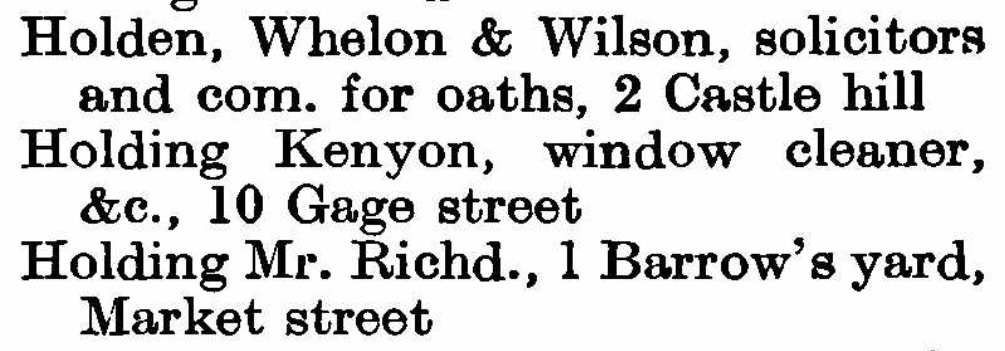
This property doesn't look any bigger than how I imagine #3 would have been, but now the family boasted 8 children between the ages of 16 and 1 years of age, with the youngest of the family, Doris, not yet born. Doris was, at this point in history, not yet a twinkle in her father's eye; she was born in 1914. Accommodating so many quickly growing people must have been a squeeze. By 1911, however, Kenyon, my great grandfather, was self employed as a master window cleaner, and employing two of his own sons. With the store front below, and his name, address, and business listed in the 1912 directory, I have assumed that they also had the store on the ground floor as part of their accommodation. Perhaps some of the older children slept in the back room of the shop.

Bulmer's History and Directory of Lancaster and District, 1912-13

The family remained at 10 Gage Street until at least 1920, after which they took a change of address and a change of career, by running a public house and hotel on nearby Penny Street. Before that move, the family had experienced the great loss of the eldest sons, Richard and Frank who both died in WWI. Prior to their move, and in their last months of living at 10 Gage Street the family would have numbered mum and dad, Sarah Annie and Kenyon, plus kids Lily, Lena, Joseph, John, Olive, Kenyon, and Doris; the children being between the ages of 6-22. That would have been 9 people, the majority of them being adults, or teenagers, all living, cheek by jowl, in this small home.

Gage Street can be see in this map, on the north west corner of Dalton Square.

This article by Psychology Today explains how large families can impact sibling relationships in a positive way. 

"With a bunch of children, siblings in a large family may see themselves as a team, helping to create closeness. Studies actually do show that children from larger families are more likely to be altruistic, cooperative, and interdependent than children from smaller families."

So, whilst there were undoubtedly fractious moments, it's more than possible that the family did indeed rub along rather nicely together. In fact memories of family gatherings, that happened regularly, when I was a child, suggest that this was indeed the case with the Holding siblings.

As the surviving children grew up, and started families of their own, the Holdings scattered to other parts of the country, and beyond. In an effort to keep the family bonds from breaking, the Holding children, and their children, started to hold regular, annual family days. Family Days involved one small part of the large extended family hosting everyone else; brothers, sisters, their children, and their grandchildren. People would bring dishes and drinks to share, and homes were overrun by everyone from marauding children to seniors in garden chairs, all to the sound track of laughter, chatter, and sometimes tears. 

There was certainly a sense of closeness, and a team-like culture, evident on those family days. I have some pretty blurry memories of Family Days, which I found all a bit overwhelming as a young child, as I didn't know that part of my family very well. We lived at the other end of the country from most of these relatives, and as such did not see them very often. But I what I do remember is a strong sense of safety, love, and kindness amongst this gang of somehow familiar strangers. Perhaps the ethos of the family I sensed as a young child, was in part, a result of the childhoods those siblings had enjoyed, as members of that large family.

The Holding Siblings, minus Doris, who was not yet born when the photo was taken, circa 1912

I wish that I had spent more time talking with the original Holding siblings; hearing their stories of yesteryear, and taking note of exactly how many Lancaster pubs and hotels the family had run over the years. But who would have known at that young age, that I was to develop this fascination in genealogy.

Whilst large families have definitely been on the decrease since the Victorian era, multi generational living does appear to be on the rise. Statistics Canada (a Canadian Federal Government agency) reported a study in recent years that recorded an increase of 11% of intergenerational households since 2001. It seems likely that whilst my children haven't experienced a large family upbringing, there is a high chance that their children, my grandchildren (should they have any), will at least enjoy a multi-generational home; and right now, I'm not sure how I feel about that!

#Holding

******************************************

https://www.robgolfi.com/blog/the-growing-trend-of-multigenerational-living-in-canada/

https://maps.nls.uk/geo/explore/#zoom=18.0&lat=54.04788&lon=-2.79754&layers=117746212&b=1&o=100

https://www.psychologytoday.com/ca/blog/band-brothers-and-sisters/201207/fighting-piece-mom-family-size-and-sibling-relationships#:~:text=With%20a%20bunch%20of%20children,than%20children%20from%20smaller%20families.

In the Beginning; How My Genealogy Journey Started

Back in 2016, on New Year's Day, my mother mentioned how October 2015 had marked what would have been the 100 birthday of her mother, my...